Happily Ever After Stories

Happily Ever After: Minnie and the Awtrey-Hammack Family

Once upon a time, a bone-thin pup was used for breeding. When the breeders didn’t want her anymore, she went home with one of the breeder’s co-workers as a surprise for his wife, who didn’t even like dogs. They named her Lucky because they were “lucky they kept her,” but before long, she was surrendered to the Animal Protective Association of Missouri.

When Lucky arrived at the APA, she weighed only 25 pounds and had a protruding rib cage and sunken-in facial features from lack of nutrition. She was petrified, never having known a life of love and affection.

Devan Awtrey, a veterinary technician with the APA, was immediately drawn to the quaking youngster. She sent a photo of the pup, who had been nicknamed “Skinny Minnie,” to her boyfriend.

“An hour later, he said we could foster her,” Awtrey says.

She brought Minnie home to her boyfriend, two stepkids and their other pup, who warmed instantly to the newcomer. Minnie, however, took a bit of time to adjust.

“She didn’t want to do anything for the first 24 hours we had her,” Awtrey recalls. “But she perked up as soon as she got some food in her belly. I think she realized she was home.”

Two weeks after they initially brought Minnie home as a foster, Awtrey and her boyfriend filed to permanently adopt Minnie. and the pup became the newest member of their family in July.

In the months since then, Minnie has made herself completely at home. She’s best friends with Awtrey’s other dog, and they will “lick each other’s faces for hours.” Minnie waits patiently while Awtrey’s 7-year-old stepdaughter paints her toenails and even enjoys bath time when it arrives. Her favorite activities include chasing squirrels and going for car rides.

“She also loves having her picture taken, and she’s got a goofy snaggletooth that catches on her upper lip,” Awtrey says. “She’s looks like a little gremlin. It’s so cute.”

One of Awtrey’s favorite characteristics in Minnie is that she’s a mediator.

“If the kids are arguing, she’s the first one to come in and literally put herself in the middle of whatever is going on,” Awtrey says. “If we’re play-fighting in the kitchen, she comes up out of nowhere and bulldozes us.”

Even though she’s now 60 pounds instead of 25, the 2-year-old pup still has the nickname of “Skinny Minnie” whenever she visits her old friends at the APA. Luckily, thanks to the love of Awtrey and her family and the staff at the APA, Minnie will truly never, ever be “Skinny Minnie” again.

“She’s such a good dog,” Awtrey says. “She just kind of hopped into our lives.”

This story was originally published at laduenews.com. Read it on LN’s website here.

Ladue News Feature Stories

Game on at Saint Louis Science Center

In October, the Saint Louis Science Center revealed its latest offering: a 7,500-square-foot free interactive exhibit called GameXPloration. The exhibit focuses on how games affect all of humankind and how aspects of psychology, neuroscience and technology each play a role in the world of games.

Found around the left corner from the main entrance, GameXPloration immediately draws in the museumgoer with its cool-colored lighting, reminiscent of arcades and retro-style video games. Although it’s designed to be particularly enticing to teenagers, project manager Christina Carlson notes that there’s something for everyone within the exhibit.

GameXPloration takes the visitor through five different “worlds,” starting with the early days of games all the way up to gaming as it is today. Visitors have the chance to explore what the games are, who plays them and why they’re important.

“We want to look behind why games are so central to humankind,” Carlson says. “What’s the reason games are so compelling? What do they teach us? What do they tell us about technology, and how is it being harnessed for games?”

The first world contains areas to play traditional board games, along with exploring chess in a different way – vertically. From there, visitors to the second world consider the word technology and how its use in games has morphed over time: from ancient civilizations creating rubber balls out of tree sap to games on mobile devices. This world contains a massive two-person Nintendo Entertainment controller where visitors can play Super Mario Brothers and a chance for museumgoers to experience the first widely known video game, SpaceWar! They’re also able to peek inside a variety of game consoles to gain a better understanding of how the complicated devices operate.

“We have all these devices, and many people have no idea what’s in them or how they function,” Carlson says. “This is one way to get people to start thinking about that.”

GameXPloration also has an entire section dedicated to the “rise of the arcade,” which constitutes world three. According to the center’s website, games satisfy many core human needs and motivations, including autonomy (desire to have freedom of choice), competence (desire to control outcomes and master skills) and relatedness (desire to be connected to others). This third world explores arcades through these needs and motivations while allowing the visitor to play favorites like Atari 2600: Pitfall, Pac-Man, Space Invaders, table tennis played through a tube and an eight-player version of foosball.

From these classics, the visitors move into the fourth world: “a new reality.” This section is where the center has integrated some of recent years’ most cutting-edge technology including virtual and augmented reality – which Carlson says people often confuse. Virtual reality, defined as an artificial, computer-generated simulation or re-creation of a real-life environment or situation, provides a more immersive experience, according to Carlson. Augmented reality layers computer-generated enhancements atop an existing reality in order to make it more meaningful through the ability to interact with it.

“There’s the opportunity to learn about how both can affect your perception of the world,” Carlson says. “We really wanted this exhibit to be a chance for people to experience technology they might not get to try in their everyday lives.”

Beyond a world created for the gamer to experience, GameXPloration also features a section for attendees to become a game creator. And no, learning to code isn’t part of the requirement! In the fifth world, visitors will learn how game developers approach designing games and even get the chance to play games developed by local companies, like Pixel Press’ Bloxels.

Overall, the exhibit features more than 30 interactive components and games – many of which will be changed out at least quarterly in its yearlong run so no two visiting experiences are the same. Plus, it’s the only gallery at the museum to be co-developed with the center’s audience members: Center staff engaged teens from their Youth Exploring Science Program to help develop the exhibit from its early stages. The teens played an integral part in making sure the exhibit featured places to just hang out and play popular games like Rocket League – along with its many educational components.

“Everyone involved was passionate about some aspect of putting this exhibit together,” Carlson says. “We really harnessed the staff’s interests in what they loved, and it all came together in just six months.”

This story was originally published at laduenews.com. Read it on LN’s website here.

Ladue News Feature Stories

Evocative Aromas

Grandma’s house when you were younger. A freshly picked homegrown tomato. That boutique hotel where you stayed on your favorite vacation.

Particular smells are instantly transportive, summoning places and memories often long-forgotten. This element is something St. Louisan Natalie Van Hee set out to pursue, and she started Glow Candle Co. in 2014 in hopes of re-creating some of her favorite and most nostalgic scents.

She had been working for a large company that downsized, and she found herself at a crossroads.

“I’ve always worked for someone,” she says. “I was at a point where instead of pursuing someone else’s passions, I wanted to do something I was interested in and could grow.”

Van Hee didn’t have a particular path in mind at first. She was a few months away from getting married and spent some time contemplating her passions. After she and her husband got married and did some traveling, an idea sparked. On returning home from different places, Van Hee found herself searching for fragrances she had encountered along the way to help reminisce about her travels. She would find herself gravitating toward particular scents depending on what was going on in her life at the time. Thus, she began experimenting with creating candles of her own, wanting to capture memories in their scents.

It wasn’t easy, though.

“I can’t say I had a background in making candles,” she says with a laugh. “I figured it out after testing, research and plenty of trial and error.”

From the get-go, however, Van Hee knew going the all-natural route was important to her. She was disheartened about the number of companies that use an array of additives and chemicals, so she stayed away from them. In Glow Candle Co. candles, she uses soy wax from American-grown soybeans, cotton wicks, premium-grade fragrance oils and no dyes. The candles burn for 70 hours and are nontoxic.

Her current line features two collections: the classic collection and the holiday collection. The classic collection consists of scents including Van Hee’s favorite – white tea – along with heirloom tomato, arugula, Himalayan pomegranate and more.

“White tea is my favorite because it reminds me of my favorite hotels when we were in Kauai,” she says. “I searched for a long time to try to find the right combination of fragrance oils for it. It’s a clean, refreshing fragrance, and I have it burning 24/7.”

The holiday collection brings the smells of the season with fragrances like pumpkin spice, white pine and aspen embers. One of her holiday best-sellers is called The Saint Nic, and Van Hee says she started pouring them in June in preparation for the holiday season.

She also speaks fondly of more unique-sounding scents like the heirloom tomato candle. She says she has a customer who often buys it for its nostalgia factor.

“His family owned and ran a tomato farm growing up, so you can tell the fragrance is very nostalgic to him,” she says. “I really enjoy seeing customers connect with a fragrance.”

Right now, Van Hee is in the midst of the holiday season – a busy time for her business. She’s been running operations from her home since its inception but hopes to find a small storefront to work out of in the future. Her gift boxes for wrapping up the candles recently debuted, as well, adding another angle of beauty to her creations.

“I have put a lot of time and focus into creating packaging that is classic, clean, can fit into anyone’s home, yet does not go unnoticed,” she says. “All of my labeling includes some type of pressed gold foil. The boxes I’m introducing in November will be perfect for holiday gifting and feature the same pressed-gold foil elements.”

Glow Candle Co. candles are available on her website for $30, with select bundles available at discounted rates. Area residents can also find her products locally at The Rusted Chandelier, Paisley Boutique, The Gifted Gardener, Mister Guy Women’s, Klutch, Mary Tuttle’s Floral and Gifts, Buoyant Float Spa, There She Goes and Gin & Kin.

In each candle she pours, Van Hee strives to have each customer connect with a scent.

“Each candle purchased should connect consumers with an experience, person or place,” she says. “Whether it be something from their past or a new fragrance they can’t get enough of … this is really important for me and is a big part of what keeps me inspired.”

This story was originally published at laduenews.com. Read it on LN’s website here.

Ladue News Feature Stories

Agents of Change

With a mission to inspire and enable all young people to reach their full potential as productive, responsible and caring citizens, the Boys & Girls Clubs of Greater St. Louis has started an incredible new endeavor: the Ferguson Teen Center of Excellence.

Just one year after celebrating its 50th anniversary in St. Louis, the organization took the first official step in launching a $12.4 million facility that will house everything from a nutrition-education center to a maker space. The sum involved includes construction and three years of operating. President Flint Fowler and nearly 150 other community supporters broke ground on the 26,856-square-foot building in September on the site of the former Ferguson Ponderosa.

Once a plan was formulated, the Boys & Girls Clubs of Greater St. Louis launched a $25 million campaign to operate and partially sustain programs and services in north St. Louis County. As of Oct. 24, Fowler says the group is at about $17.7 million – all from a mix of private donations and corporate sponsorships.

After the official groundbreaking ceremony on Sept. 13, workers started initial foundation and cement work before winter arrives. They plan to open the facility at the start of the 2019-20 school year – in September or October of next year. The building’s design, done by local architecture and design firm ARCTURIS, includes a gymnasium, a teaching kitchen, a garden, a maker space/innovation center, an auditorium, a recording studio with video equipment, a game room, an art room and a fitness area. It will also include a counseling office, where a social worker can do intake work and meet one on one with individuals, small groups and families. It will offer after-school and summer programming to teens ages 12 to 18 in the North County area.

“We think it’s going to be a great attraction to the neighborhood,” Fowler says. “It’s one of the pieces it’s going to take to really transform that area. This is one of the first – if not the first – freestanding teen centers within the Boys & Girls Clubs family.”

But it’s been many years in the making. The idea of a Boys & Girls Clubs facility in the Ferguson area first surfaced around 2012, and Fowler and his team had been working on a growth strategy to start some clubs in North County with the Ferguson-Florissant School District. However, they couldn’t find a lot of traction. When Michael Brown was shot and killed in Ferguson in August 2014 and rioting began, the Boys & Girls Clubs of Greater St. Louis began to get phone calls from concerned community members wanting safe spaces for their children to spend time outside of school. The organization received an initial call from the Ferguson Youth Initiative and opened a club in Ferguson Middle School in 2015.

“We expected around 110 to 115 kids, but we had about 260 that first year,” Fowler says. “That told us there was a major need.”

They subsequently opened a second club at a neighboring school in order to house the middle school kids and the elementary kids separately. The following year, the group opened a club in the Riverview Gardens School District and Highland Elementary – two of the schools that were impaired by the rioting.

“More needed to be done,” Fowler says. “We always had it in the back of our mind to build this facility.”

The Boys & Girls Clubs of Greater St. Louis found that the missing element to these school-based clubs was the opportunity to serve teenagers. They decided to keep the school-based model for younger children and work on developing a space for teens that would be safe, attractive and pressure-free.

“In our research, teens like having their own space,” Fowler says. “They want to learn about career opportunities and get a chance to veg out with their friends. A number of teens in the area who aren’t participating in sports or other after-school activities are basically on their own until their parents get home from work. We wanted to be more intentional about serving that group.”

The location selected for the center gives the club an opportunity to serve not only Ferguson-Florissant teens but also those from Dellwood, Normandy and Jennings, as it sits equidistant among all those cities. Fowler and his team then set out to build a space that allows teens to prepare for careers, teach them about leadership and give them a chance to practice healthy lifestyles. The St. Louis club convened a group called Great Think to “facilitate innovative public-private collaborations,” according to the organization’s website. Great Think brought together community leaders and representatives from colleges, the military, law enforcement, nutrition, education and health care, to name a few.

“We broke them up into groups and talked about what the club should look like if you’re doing it through a teen’s eye,” Fowler says.

The groups brought up incorporating all aspects of STEAM (science, technology, engineering, arts and math), along with providing the young people with opportunities for careers and broadening their understanding of what’s available to them.

“We plan to assess each member’s career interest and aptitude [to] align work experiences, speakers and other activities with the education and training necessary to that field,” Fowler says. “What do they have a knack for, and how can we match that up to long-term career interests, and what educational experiences or training do they need to get there? We want to line up their interests and skills and flood them with opportunities to learn more.”

Another important component that came out of the planning was the leadership and civic-engagement aspect.

“One of the great things we saw come out of [the Ferguson riots] was the large number of young people [who] wanted to become active in their community,” Fowler says. “We see a lot of leadership coming out of young people in these communities where safety and opportunity are at risk. They’re holding officials accountable and are understanding how their voice can be heard. We want them to think about the things they can do to make their neighborhood better.”

Personally, Fowler hopes the center brings hope to the young people who access it and will help them be more successful in school, pursue their interests and be agents of change.

“If they are hopeful and inspired, they can carry what they’ve learned out into the larger community,” he says. “I hope the center brings about a sense of community that we’re all there to work for the betterment of each other.”

This story was originally published at laduenews.com. Read it on LN’s website here.

Happily Ever After Stories

Happily Ever After: D-O-G and the Duo Family

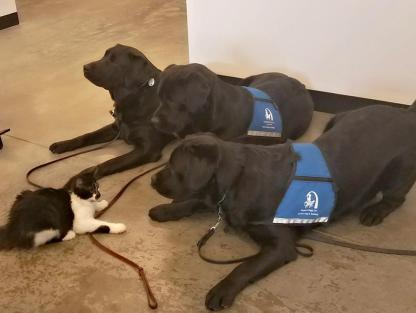
Once upon a time, a kitten lived in a barn at Netherfield Natural Farm bed-and-breakfast in Fontana, Kansas. The youngster spent his days in the barn with his brothers and sisters, mixing and mingling with the other farm animals and greeting guests who stayed at the B&B. One day in July 2017, Nadine Wenig of St. Louis’ Duo (formerly Support Dogs) stayed at the farmhouse while working with new handlers in the area. After going to the original barn to hear some music one night, she was greeted by the kitten and his siblings – most of whom scattered when she opened the door. All of them, that is, except the black-and-white one.

“He came up to me and was meowing at me,” Wenig remembers. “I picked him up, and he just snuggled right up to me. I came back later in the day, and the same thing happened. All of the kittens scattered except for him.”

Wenig and the Duo team, which has trained assistance dogs for individuals with mobility and hearing challenges since 1981, had previously discussed getting a cat to help with distraction training for the organization’s dogs. The service and hearing dogs go through two years of training to make sure they’re proficient in more than 50 skills, like opening and closing doors and picking up dropped items. Clients are often curious if Duo pups are good with cats, and Wenig thought she might’ve found the perfect candidate.

“I asked [one of the owners] that night if I could have one of the kittens out of the barn to take back to Duo,” Wenig says. “He agreed, and we started our four-hour trip back the next morning.”

During the trip home, the kitten didn’t complain at all. He was content to purr and sleep the entire ride back to St. Louis, where he hit the ground running almost immediately. Wenig took him to the vet to make sure he was up-to-date on his vaccinations, and he started his job at Duo right away. By then, Wenig had named him D-O-G, pronounced “dee-OH-gee.”

“From the minute he walked in the door, he thought he was a dog,” Wenig says. “He eats out of the dogs’ bowls and has never met a stranger when it comes to a dog. It’s made him such a useful tool around here.”

Now 1 year old, the cat spends his days lovingly tormenting the organization’s dogs in training, playfully swatting their noses and lounging on top of their crates. When the dogs are in the training rooms, D-O-G comes with. While six or seven dogs practice their “down,” the cat will meander around them and play with toys in front of them.

“He’s very much a typical cat,” Wenig says. “He wants to be held when he wants to, but he’s never scratched or bit anyone since we brought him here. He does so many silly things with the dogs. He’s a great part of our team.”

His work hasn’t gone unnoticed. On Thursday, Nov. 15, Wenig, D-O-G and other Duo representatives traveled to New York City to receive the ASPCA Cat of the Year award.

According to Duo’s website, such awards “honor animal heroes who vitally help humans or other animals in extraordinary ways, as well as people who demonstrate great commitment to assisting at-risk animals.” Following a nationwide call for nominations, D-O-G was selected for the Cat of the Year category – an honor Wenig says he absolutely deserves.

“You can’t be around him without laughing,” she says. “He’s a part of our organization, even though he’s a cat. He helps us in so many ways.”

This story was originally published at laduenews.com. Read it on LN’s website here.
Ladue News Feature Stories

Little Darling Duds

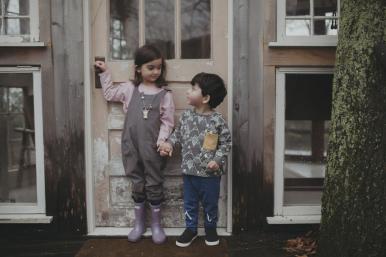
Kinnari McDevitt grew up at a crossroads of cultures. She was born in India and lived there until she was 14 years old before her family immigrated to Chicago. She and her family adapted to life in the States, and McDevitt came to St. Louis to earn a master’s degree in engineering before going to work for a major corporation. During her time as an engineer, she longed for a creative outlet and began creating clothing for her two nieces. The girls wanted to wear dresses, but didn’t want to wear the traditional Indian garb McDevitt was often inspired by.

“I felt like there was a middle ground there that all kids could enjoy,” she says. “That’s where it all started.”

After she and her husband, Greg, got married in 2011, the pair took a trip to India the following year. McDevitt had always been inspired by the vibrant colors and textiles of her homeland and was interested in seeing the Indian culture from his American perspective.

“In America, people have tons of clothes and go buy new things every season,” she says. “It’s a very different way of consuming. In India, people have a lot of respect for types of fabric. They’re more aware of what they’re wearing – who made it, where they bought it. We have no idea where our clothes come from here.”

Inspired by what she’d seen on her trip and the desire to create “clothing that had soul in it,” McDevitt started Lali Kids in 2013. Lali means “little darling” in Hindi, and McDevitt has made it her mission to create fair-trade children’s clothes out of the company’s home base of St. Charles. She spent months developing the brand’s first collection: a small set of 15 pieces of little girls’ clothing that launched in 2015. Since then, McDevitt’s been developing new collections for each season – most recently, the fall 2018 line. She bases each collection around a memory or feeling, gathering images over time that capture that state in her mind. From there, she develops a color palette for the season. The current line, for example, is based around the Nordic concept of hygge – the feeling of coziness and comfort that comes with the colder weather.

“Hygge is the underlying theme of the entire collection,” McDevitt says. “We had a print designer design a print that looks like a watercolor painting of a magical forest. If you look closely at it, it give you the sense of a walk in the woods.”

Another piece from the collection is a double-layered dress that has two different fabrics layered together.

“It’s so unique in that there’s a playfulness to it,” McDevitt says. “There’s one pattern on one side, but if you roll up the sleeves, it’s another pattern. It’s very festive and fun for the season.”

New to the Lali Kids line is the boys’ collection, which recently launched. McDevitt notes the popularity of the collection’s arrow pants, which are garment-dyed. During the process, the garment is made first and then dyed, instead of vice versa, like most pieces.

“There’s some color variation there, and they’re a soft knit cotton,” she says. “They’re fun and interesting in the way they look. They check all the boxes I try to accomplish in my pieces.”

Nearly all Lali Kids pieces are made in India – aside from a set of fur vests that McDevitt made herself here in St. Louis and alpaca wool pieces from Peru. She says she chose to have her line manufactured in India because that’s where all the fabrics she wanted to use were, and she wanted to make a difference in the lives of the makers.

“I’ve seen the struggle of what women in India often go through,” she says. “They often lack education and don’t have autonomy to leave their [low-income] lives. It’s important for me to find people who would benefit from what I’m doing.”

McDevitt found a small factory in India that employs mainly women who are provided fair wages and have flexible hours to make her pieces. She designs the patterns for her fabrics herself and provides measurements to the weavers and printers in India, who turn around samples for her to review and photograph. Once adjustments are made, the pieces are manufactured and put out into 60 boutiques both nationally and internationally.

The line was picked up by notable national retailers like Anthropologie and Maisonette and can also be found in Ladue at City Sprouts. McDevitt says City Sprouts owner Molly Curlee has been a Lali Kids supporter “since the day we launched” and was so excited to carry the line and give feedback. Aside from City Sprouts, Lali Kids can be found at pop-up shops throughout the season, including a holiday one at the Saint Louis Galleria’s Anthropologie in early December.

These developments have led McDevitt’s once-small concept to take off more than she had anticipated. Luckily for McDevitt, each season and collection brings new opportunities to be creative.

“Creating is a reward in itself,” she says. “I love seeing children enjoying the clothes and getting comments on Instagram about ‘This is my daughter’s favorite dress!’ It’s fun to know the intentions are coming through in what we’re doing.”

One of the best parts of being the Lali Kids founder, though, is McDevitt’s chance to spend time with her 2½-year-old son, Aiden.

“We were able to keep him in our studio and work around his nap time,” she says. “It’s really rewarding because I’ve gotten to spend those two years with him. Even now, he only goes to school part time. I feel like I didn’t miss anything, and that’s the biggest reward for me on a personal level.”

This story was originally published at laduenews.com. Read it on LN’s website here.

Dancing Astronaut

Varien weaves a dark and vulnerable web in ‘Death Asked A Question’ [EP Premiere + Interview]

In his seven years producing as Varien, Nick Kaelar has consistently surpassed genre constructs and proven himself a true mastermind of the electronic music realm. Having always fostered an affinity for music and composing, Kaelar made a name for himself with notable works such as his Skrillex orchestral suite and innovative originals like “Valkyrie” with Laura Brehm and “Moonlight” with SirensCeol and Aloma Steele. For years, his music has seamlessly blended industrial, metal and orchestral elements into modern EDM, and he’s become a figurehead for a shadowy genre all his own.


On Halloween in 2016, Kaelar released his noteworthy My Prayers Have Become Ghosts EP.  The seven-track body of work fully encompassed his dark style with components of ambient, baroque, and progressive metal.

“I still consider My Prayers to be my best work,” Kaelar says. “It’s a very artistic and accurate representation of what Varien means to me. I got to explore all the roots.”

Though riding the high of My Prayers in 2016, the following year would prove to be full of hardship for Kaelar. Both of his parents became ill, and the nine-year relationship he was in “started to fall apart at the seams.” With these factors on top of a grueling producing schedule, Kaelar sunk into a deep hole of depression and anxiety, overcome by elements in his life he felt he had no control over. Wanting to take a step back and clear his mind, he deleted his social media accounts and disappeared from the internet scene entirely. After six years of making music as a full-time job without a break, he took 2017 to take care of himself mentally and emotionally — reemerging at the start of this year ready to get back on the horse.

He returned in February 2018 with “Blood Hunter” and has since released a variety of singles and the title track to his latest endeavor: the Death Asked A Question EP. Where My Prayers marked the end of “Varien 1.0,” this year’s releases have been all about part two of Kaelar’s journey as an artist.

“I’ve been staying positive this year and working harder than I’ve ever worked before,” Kaelar says. “That’s led to lots of days and weeks in this year where I have had a lot of struggles with depression and bouts of panic and anxiety, though… and even small flirtations with self harm.”

In early September, Kaelar released a beautifully haunting track called “Oh, Sparrow…” and was open with his fans about the story behind it. “I was sitting in my car and had that depressive, thousand-yard stare,” he recalls. “I had planned to go home that night and take some [Oxycontin] and go back to old addictive, escapist habits. Instead, I made a track and played around with an idea. I woke up the next day feeling better.”

He calls this year’s re-acclimation to the music scene a “crawl,” but says he’s in a “much better place” now. “I’ve definitely found out I’m a lot stronger than I think I am,” he says.

“The main thing that I preach and practice often is to never forsake your future self and own the consequences of your actions,” he says. “I’m working really hard now so my future self can be happy and thank my past self. A lot of great opportunities have come my way, and it’s starting to feel like people believe me when I say I’m here.

And here he is.

The new Varien EP, Death Asked A Question, is out October 26 via Most Addictive and is premiering here a day early on Dancing Astronaut. Fans old and new will find differences between this body of work and My Ghosts, as Kaelar seeks to explore things that “aren’t quite so kosher or as ‘Varien’ as people would think.”

“In my entire discography spanning back to 2011 as Varien, there’s always a sense of very deliberate storytelling. This EP is nothing like that. It’s a refraction. In the same way a mirror might bounce light, I’m bouncing the emotions of this year and last year into music format. It’s the most personal experience. It’s very raw. It’s very vulnerable.”

This story was originally published at dancingastronaut.com. Read it in full on DA’s website here.

Ladue News Feature Stories

Cut From the Same Cloth

Grandmas are the cornerstones of many families. They’re often the ones who bring everyone together and are the matriarchal foundation for generations to come. In the case of sisters Jenny Chao and Emily Duddy, their grandmother is not only one of their greatest inspirations but also the reason their monogramming business, Gin & Kin, exists.

Chao and Duddy have always been each other’s closest confidants. The pair were inseparable even when Chao moved to Fort Worth, Texas, to start a monogram and embroidery business, Initially Yours, with a friend in 2013. Duddy and the rest of their St. Louis-based family missed Chao and constantly asked if and when she was coming back to the area. The two sisters had kicked around the idea of pursuing a monogram business in St. Louis in the distant future, and Duddy told her sister that if she came back to St. Louis, they could start in on their ideas right away. Ginny, the girls’ grandmother, was an avid supporter of the idea, and said that if Chao came home, she’d help them get started.

Chao agreed and made the move back to St. Louis in 2016 after being away for four years. Duddy, who went to school for textiles, was excited to start combining her keen eye for fabrics and colors with Chao’s enthusiasm for monogramming in all forms. Though she went to school for child and family development and early childhood education, her passion for monogramming led her to teach herself how to use embroidery machines and how to operate a business. Duddy and Chao decided to call their venture Gin & Kin, named after Grandma Ginny, and started creating in late summer 2016. For two years, they operated out of both of their homes, creating vibrant, beautiful monogram pieces amid the chaos of their lives. Duddy had just had her son, Miles, and Chao has three large rescue dogs. Then-87-year-old Grandma Ginny assisted her granddaughters in their work, helping in the cleanup part of the process by removing the backing and trimming threads. Working out of their homes weighed on both of them, and they considered looking for a storefront where their clients could see their creations in a professional, laid-out manner. In love with the Skinker/DeMun area, they would walk by what was then Dot Dot Dash Boutique, admiring the small but modern space.

“We knew we didn’t want a huge space, but we wanted a space where people could come see our products without having to come to our house,” Chao says.

They had decided to wait to open a storefront until Miles was in elementary school; however, in June of this year, opportunity came knocking.

“We knew the owner of the building [at 6334 Rosebury Ave.], and she called us to let us know the former tenant had decided not to re-sign their lease,” Duddy says. “She told us that we’re what she wanted in the space. Were we interested?”

Chao and Duddy’s years-off plan kicked into overdrive when they accepted and signed the lease. (Dot Dot Dash moved to a new storefront down the street off DeMun.) They moved their embroidery machines into the 362-square-foot space and opened their doors to the public at the beginning of September.

“It’s been a great outpouring from the community since we opened,” Duddy says. “We’ve had a lot of foot traffic, which has really helped us launch. We had good business and clients before, but it’s hard to take something super-seriously when you’re doing it out of your home. This makes it more substantial.”

Gin & Kin embodies its “personalization redefined” motto by offering luxe custom monogramming and personalized embroidery services. But they don’t just offer the basic three-initial scroll script. The sisters have an entire book of sample monograms that come in a range of fonts, numbers of initials, sizes and shapes. Customers can bring in everything from sheets to napkins to towels to have a monogram stitched on. Chao and Duddy also offer a variety of towels, blankets and other wares that can be embroidered. One of their favorites is the fouta, a Turkish towel that “gets softer with every wash,” Chao says. They also offer a variety of baby products, like swaddle blankets and heirloom gift sets. Monograms can be added to all items for $12 to $15, priced by scale of design, with one week to complete. The sisters are also able to turn an order around in 24 hours if needed.

“Jenny’s the monogram expert, and I help customers choose colors and fabrics,” Duddy says. “We make a great team.”

In addition to monogram and embroidery services, Gin & Kin offers leather stamping, vinyl decaling and art digitizing. They’re also looking to work with more engaged couples for all their wedding needs – from brides’ and bridesmaids’ getting-ready pajama shirts to cloth napkin embroidery.

As they grow their business, the sisters are passionate about carrying products from women-owned, ethically made lines. They are also excited to partner with other St. Louis businesses down the road and have already worked with local designer Blair Dobson of Hello Dobson for embroidery.

In the end, though, their entire venture comes down to family. Duddy says she and her sister are “truly inseparable” and couldn’t imagine pursuing this project with anyone else.

Chao agrees: “We’d be with each other anyway, so we might as well be doing something fun with the community and small businesses.”

Gin & Kin is also about making their 89-year-old grandma proud. She sewed their graduation dresses when they were younger and taught the girls how to sew and crochet. When the sisters held a sneak peek opening, Grandma Ginny sat in a chair at the front of the storefront all day, making sure every person who walked in knew that she was the “Gin” of Gin & Kin.

“A lot centers around her and making her proud,” Duddy says. “This is her legacy.”

This story was originally published at laduenews.com. Read it on LN’s website here.

Ladue News Feature Stories

Hooked on Herend

For close to 200 years, Herend has wowed the world with its handmade, hand-painted porcelain creations. Founded in Herend, Hungary, in 1826, the company has grown to become the largest producer of handmade porcelain in the world. Each piece’s signature patterns and attention to detail set the Herend brand apart and have made its longstanding line of goods coveted for decades.

To give Herend fans an exclusive look into the work that goes into these exquisite pieces, Chesterfield Jewelers is bringing in Herend master artist Marianna Steigervald for an event series on Oct. 29 and 30.

Steigervald grew up in the Hungarian village of Veszprém, which borders the Herend Porcelain Manufactory. She showed an affinity for art at a young age and sought to advance her education at the Herend manufactory after finishing school. Herend’s master artist curriculum consists of rigorous training, which Steigervald completed, earning the title of master artist in 1997. According to a press release, to achieve this title an artist “must excel in designing a form and its ornamentation; designing its manufacturing process; choosing, preparing and using the raw and auxiliary materials, as well as the tools and instruments necessary to make the piece; improving product quality and eliminating all errors; teaching the craft and providing expert opinion and consultation; and exhibiting the highest professional and aesthetic standards.” For a master artist’s final project, he or she must create a masterpiece for review by the Guild Masters. If the piece is done to the Guild Masters’ standards, the artist is awarded this rare designation.

“In this fast-paced society we live in where many things are created for a short shelf life, I love creating beautiful things that have a permanence to them,” Steigervald says of her work. “Not only valuable products that will be around for generations to come, but also pieces that are a true expression of art. As an artist, I love to honor tradition, but I also enjoy pushing boundaries and discovering ways to appeal to a younger generation. It may be a cliché, but I continuously search to capture and reflect the subtle beauty in the world around me.”

At the Oct. 29 and 30 events at Chesterfield Jewelers, visitors will have the opportunity to witness Steigervald demonstrate her craft while browsing the store’s selection of Herend products. Steigervald will also be available to personalize and sign pieces for attendees, which make great gifts. Beth Castellaw, a regional sales manager for Herend USA, says customers often request messages like “Merry Christmas” or other personalized sentiments on the bottom of their Herend pieces, making them even more special and unique.

“Mariana truly enjoys meeting customers and children, and has built a loyal U.S. following,” Castellaw says. “At one event, she even tried to teach a small child how to paint. We’d love for people to come and meet her and witness her remarkable painting techniques.”

Herend figurines are distinguishable by their hand-painted fishnet pattern, which has become a signature Herend design. Castellaw says that in 1858, an inspired artist modified a fish scale design into a fishnet pattern and painted it onto the breast of a rooster figurine to imitate feathers. In the 1960s, an animal figurine was painted entirely in the fishnet pattern, and it became so popular that it became widely used on Herend figurines, with animal figurines featuring the design representing about half of Herend’s U.S. sales.

While figurines remain popular for Herend, the brand’s dinnerware line is also widely in demand. With thousands of shapes in more than 5,000 different patterns, the combinations are endless. Herend includes platters, coffee and tea services, trays, napkin rings and more and has been owned by more than 25 royal families worldwide.

“Many Reserve Collection pieces will be among the exquisite assortment of porcelain artistry presented at the event,” Castellaw says. “Mostly limited editions, the Reserve Collection pieces are art sculptures adorned with 24-karat gold accents and are meticulously handcrafted by many pairs of hands and take many hours, days and weeks to paint. Each piece is elegantly presented with a certificate and a luxury case.”

A lookbook featuring some of the unique Herend items available at Chesterfield Jewelers can be found on the jewelers’ website. Castellaw encourages those who can attend the events to do so, but notes that the items will also be available for “preshopping” on the site.

Steigervald says she’s looking forward to the event series and is eager to share her art with those who attend.

“For me, the Herend brand is synonymous with perfection in high-quality porcelain,” she says. “The manufactory’s success story has been unbroken since the 19th century, in large part due to cherishing old traditions while embracing new artistic endeavors and technical advancements, as well. Herend’s hand-painted porcelain, whether a small figurine, a piece of giftware or a dinner service for 20, is a beautiful work of art.”

This story was originally published at laduenews.com. Read it on LN’s website here.

Ladue News Feature Stories

Love Beside a Lush Lake

Cecily Hoffius and Judith Bellos have been in business together for 37 years. In the decades they’ve run Ces & Judy’s Catering, they’ve seen the rise in the wedding industry and its plethora of opportunities. Intrigued by the possibilities, the successful duo shut down their Frontenac location to start a new venture: The Venue at Maison du Lac.

Previously, Hoffius and Bellos would visit friends of theirs who lived on a gorgeous 20-acre piece of private property in Catawissa, Missouri, less than an hour from the metro area. The property featured an 1840s stone house and sat right on a breathtaking lake.

“It feels like you are in another country,” Hoffius says.

When she and Bellos found out their friends were putting the property up for sale, they jumped at the chance to convert it into a wedding venue. They purchased the piece of land two years ago and got to work. As with any project, “It took longer than expected,” Hoffius says. They started construction in December 2017 and had their first wedding in July.

Due to its “another country” feel, The Venue at Maison du Lac has attracted engaged couples across the Midwest – especially those who want a getaway-type atmosphere without the lengthy travel.

“The thing that pushed us in this direction was all the people who seemed to be looking for what felt like a destination wedding but didn’t want to get on a plane,” Hoffius says. “We’ve created a destination that’s easily accessible from St. Louis.”

The premises feature a minimalist, modern building that the duo calls “the perfect blank canvas” for weddings of all shapes and sizes. It’s 7,000 square feet with high ceilings and large windows and features a deck overlooking the lake. The 19th-century stone house provides the perfect backdrop for photos and also serves as a luxury bridal room.

Hoffius and Bellos liked the idea of contrasting the rustic, countryside feel of the surrounding area with a modern steel-and-glass building, and architect Peter Tao was able to design something that fit the vision.

“We try to keep the building simple inside so the couples can turn it into anything they want,” Hoffius says. “The building sits right at the edge of the lake looking back at the stone house, so it’s a beautiful setting. We even purchased a small property next door to create a parking lot so we didn’t have to take out any trees.”

Since the site’s first wedding this past summer, Hoffius says she and Bellos have hosted three others, along with a post-funeral luncheon, a rehearsal dinner and a few parties. Though they haven’t hosted one yet, Hoffius says the space is also ideal for corporate retreat-type getaways. Despite the glass and steel, the sound quality inside is impeccable, and visitors have an opportunity to fish and explore the great outdoors, as well.

“It’s been exciting and a lot of work,” Hoffius says. “Judy and I are the ones taking visitors on tours, and we’ve had a lot of interest. We don’t quite have the landscaping look quite finished, but we are doing a lot of planting now and through the fall.”

When asked what sets The Venue apart from other wedding and event spaces, Hoffius doesn’t skip a beat.

“The setting is what sets us apart,” she says. “It’s just so beautiful out here. It’s relaxing.

After 37 years in the catering business, Hoffius and Bellos have seen countless events take place. They know what little things can really make a wedding day pop, and their new venue venture gives them the opportunity to bring that to their customers.

In addition to The Venue’s use as a prime spot for weddings and other events, the pair plans to host events for people in the Catawissa area.

“We’d love to do things in the coming years that are more inclusive to people in the area,” Hoffius says. “We could host movie nights and music nights for the public and give people a chance to see this beautiful spot.”

Hoffius says people ask her all the time when she’s going to retire, but it won’t be anytime soon.

“Long term, Judy and I just hope we are busy every day,” she says. “We love this business, and if we didn’t love it, we wouldn’t be in it. Seeing the looks on the faces of happy attendees – that’s what keeps us all going. It’s hard to give that up.”

This story was originally published at laduenews.com. Read it on LN’s website here.