Ladue News Feature Stories

Hooked on Herend

For close to 200 years, Herend has wowed the world with its handmade, hand-painted porcelain creations. Founded in Herend, Hungary, in 1826, the company has grown to become the largest producer of handmade porcelain in the world. Each piece’s signature patterns and attention to detail set the Herend brand apart and have made its longstanding line of goods coveted for decades.

To give Herend fans an exclusive look into the work that goes into these exquisite pieces, Chesterfield Jewelers is bringing in Herend master artist Marianna Steigervald for an event series on Oct. 29 and 30.

Steigervald grew up in the Hungarian village of Veszprém, which borders the Herend Porcelain Manufactory. She showed an affinity for art at a young age and sought to advance her education at the Herend manufactory after finishing school. Herend’s master artist curriculum consists of rigorous training, which Steigervald completed, earning the title of master artist in 1997. According to a press release, to achieve this title an artist “must excel in designing a form and its ornamentation; designing its manufacturing process; choosing, preparing and using the raw and auxiliary materials, as well as the tools and instruments necessary to make the piece; improving product quality and eliminating all errors; teaching the craft and providing expert opinion and consultation; and exhibiting the highest professional and aesthetic standards.” For a master artist’s final project, he or she must create a masterpiece for review by the Guild Masters. If the piece is done to the Guild Masters’ standards, the artist is awarded this rare designation.

“In this fast-paced society we live in where many things are created for a short shelf life, I love creating beautiful things that have a permanence to them,” Steigervald says of her work. “Not only valuable products that will be around for generations to come, but also pieces that are a true expression of art. As an artist, I love to honor tradition, but I also enjoy pushing boundaries and discovering ways to appeal to a younger generation. It may be a cliché, but I continuously search to capture and reflect the subtle beauty in the world around me.”

At the Oct. 29 and 30 events at Chesterfield Jewelers, visitors will have the opportunity to witness Steigervald demonstrate her craft while browsing the store’s selection of Herend products. Steigervald will also be available to personalize and sign pieces for attendees, which make great gifts. Beth Castellaw, a regional sales manager for Herend USA, says customers often request messages like “Merry Christmas” or other personalized sentiments on the bottom of their Herend pieces, making them even more special and unique.

“Mariana truly enjoys meeting customers and children, and has built a loyal U.S. following,” Castellaw says. “At one event, she even tried to teach a small child how to paint. We’d love for people to come and meet her and witness her remarkable painting techniques.”

Herend figurines are distinguishable by their hand-painted fishnet pattern, which has become a signature Herend design. Castellaw says that in 1858, an inspired artist modified a fish scale design into a fishnet pattern and painted it onto the breast of a rooster figurine to imitate feathers. In the 1960s, an animal figurine was painted entirely in the fishnet pattern, and it became so popular that it became widely used on Herend figurines, with animal figurines featuring the design representing about half of Herend’s U.S. sales.

While figurines remain popular for Herend, the brand’s dinnerware line is also widely in demand. With thousands of shapes in more than 5,000 different patterns, the combinations are endless. Herend includes platters, coffee and tea services, trays, napkin rings and more and has been owned by more than 25 royal families worldwide.

“Many Reserve Collection pieces will be among the exquisite assortment of porcelain artistry presented at the event,” Castellaw says. “Mostly limited editions, the Reserve Collection pieces are art sculptures adorned with 24-karat gold accents and are meticulously handcrafted by many pairs of hands and take many hours, days and weeks to paint. Each piece is elegantly presented with a certificate and a luxury case.”

A lookbook featuring some of the unique Herend items available at Chesterfield Jewelers can be found on the jewelers’ website. Castellaw encourages those who can attend the events to do so, but notes that the items will also be available for “preshopping” on the site.

Steigervald says she’s looking forward to the event series and is eager to share her art with those who attend.

“For me, the Herend brand is synonymous with perfection in high-quality porcelain,” she says. “The manufactory’s success story has been unbroken since the 19th century, in large part due to cherishing old traditions while embracing new artistic endeavors and technical advancements, as well. Herend’s hand-painted porcelain, whether a small figurine, a piece of giftware or a dinner service for 20, is a beautiful work of art.”

This story was originally published at laduenews.com. Read it on LN’s website here.
Ladue News Feature Stories

Love Beside a Lush Lake

Cecily Hoffius and Judith Bellos have been in business together for 37 years. In the decades they’ve run Ces & Judy’s Catering, they’ve seen the rise in the wedding industry and its plethora of opportunities. Intrigued by the possibilities, the successful duo shut down their Frontenac location to start a new venture: The Venue at Maison du Lac.

Previously, Hoffius and Bellos would visit friends of theirs who lived on a gorgeous 20-acre piece of private property in Catawissa, Missouri, less than an hour from the metro area. The property featured an 1840s stone house and sat right on a breathtaking lake.

“It feels like you are in another country,” Hoffius says.

When she and Bellos found out their friends were putting the property up for sale, they jumped at the chance to convert it into a wedding venue. They purchased the piece of land two years ago and got to work. As with any project, “It took longer than expected,” Hoffius says. They started construction in December 2017 and had their first wedding in July.

Due to its “another country” feel, The Venue at Maison du Lac has attracted engaged couples across the Midwest – especially those who want a getaway-type atmosphere without the lengthy travel.

“The thing that pushed us in this direction was all the people who seemed to be looking for what felt like a destination wedding but didn’t want to get on a plane,” Hoffius says. “We’ve created a destination that’s easily accessible from St. Louis.”

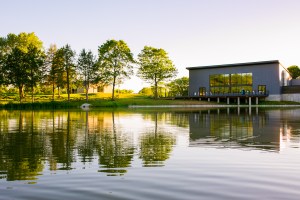
The premises feature a minimalist, modern building that the duo calls “the perfect blank canvas” for weddings of all shapes and sizes. It’s 7,000 square feet with high ceilings and large windows and features a deck overlooking the lake. The 19th-century stone house provides the perfect backdrop for photos and also serves as a luxury bridal room.

Hoffius and Bellos liked the idea of contrasting the rustic, countryside feel of the surrounding area with a modern steel-and-glass building, and architect Peter Tao was able to design something that fit the vision.

“We try to keep the building simple inside so the couples can turn it into anything they want,” Hoffius says. “The building sits right at the edge of the lake looking back at the stone house, so it’s a beautiful setting. We even purchased a small property next door to create a parking lot so we didn’t have to take out any trees.”

Since the site’s first wedding this past summer, Hoffius says she and Bellos have hosted three others, along with a post-funeral luncheon, a rehearsal dinner and a few parties. Though they haven’t hosted one yet, Hoffius says the space is also ideal for corporate retreat-type getaways. Despite the glass and steel, the sound quality inside is impeccable, and visitors have an opportunity to fish and explore the great outdoors, as well.

“It’s been exciting and a lot of work,” Hoffius says. “Judy and I are the ones taking visitors on tours, and we’ve had a lot of interest. We don’t quite have the landscaping look quite finished, but we are doing a lot of planting now and through the fall.”

When asked what sets The Venue apart from other wedding and event spaces, Hoffius doesn’t skip a beat.

“The setting is what sets us apart,” she says. “It’s just so beautiful out here. It’s relaxing.

After 37 years in the catering business, Hoffius and Bellos have seen countless events take place. They know what little things can really make a wedding day pop, and their new venue venture gives them the opportunity to bring that to their customers.

In addition to The Venue’s use as a prime spot for weddings and other events, the pair plans to host events for people in the Catawissa area.

“We’d love to do things in the coming years that are more inclusive to people in the area,” Hoffius says. “We could host movie nights and music nights for the public and give people a chance to see this beautiful spot.”

Hoffius says people ask her all the time when she’s going to retire, but it won’t be anytime soon.

“Long term, Judy and I just hope we are busy every day,” she says. “We love this business, and if we didn’t love it, we wouldn’t be in it. Seeing the looks on the faces of happy attendees – that’s what keeps us all going. It’s hard to give that up.”

This story was originally published at laduenews.com. Read it on LN’s website here.
Ladue News Feature Stories

A Revival of Grand Proportions

It all started with some motorcycles.

The year was 1999, and Steve Smith was looking for a place to keep a couple of vintage motorcycles. He had three young children at home and had run out of room in his garage, so he set out to find a small building on the fringe of downtown St. Louis where he could restore the bikes as a hobby. He happened upon a building for sale at 3323 Locust St. in the Grand Center Arts District.

“When I bought the building, I would’ve never imagined 20 years later what that would lead to,” he says.

Smith is the CEO and a founding member of architecture company Lawrence Group. He started the company with two of his fellow University of Kansas design school graduates in 1983 and has been growing his company ever since. One of Lawrence Group’s biggest clients, Saint Louis University, approached him in the early 2000s about buying the building he was storing his motorcycles in, and Smith agreed an

d moved his collection to another building nearby.

“When my motorcycle collection had become a big motorcycle collection,” Smith says, “I thought, ‘Wouldn’t it be cool to open it to the public and make it a unique ‘art of the motorcycle’ exhibition?’ That’s what led to The MOTO Museum.”

The museum opened at 3441 Olive St. in 2007 and contains almost 100 unusual bikes – mostly from Europe and around the world.

“It was a hobby on steroids,” Smith says. “[The collection] went from four motorcycles in 1999 to about 100 in 2006.”

When visitors to the museum inquired about hosting events in the space, Smith was enthusiastic about the idea but had no way to provide food for fundraisers and parties. This led to the development and opening of Triumph Grill in 2008 and the eventual opening of Hotel Ignacio next door, as well.

“Over the years, one thing has led to another – never with any real master plan,” he says. “It’s all been opportunities presenting themselves and acting on them. It’s also been realizing that both Grand Center and its great institutions are great places to be investing time and treasure to make a greater neighborhood.”

On Friday, Sept. 28, Grand Center Inc. honored Smith for his accomplishments at its annual gala, One Thousand and One Art Filled Nights. The event at The Big Top helps the Grand Center Arts District continue to establish its role as a world-class arts and business district. Smith says he’s humbled by the honor and will continue to work on making St. Louis a better place to live.

“Every community has its challenges, and we have ours, but I feel like we’re at the cusp of a new chapter in the history of St. Louis,” he says. “It’s rewarding to be a part of it.”

As the city moves into autumn 2018, there are nearly $8 billion in projects happening between the Gateway Arch grounds and Washington University in St. Louis. Grand Center and St. Louis’ midtown sit in the middle of that area geographically, making it an ideal hub for innovation and investment.

“As a region and country, we’re moving from a manufacturing economy to a knowledge economy,” Smith says. “The knowledge economy is tethered to institutions of higher education and innovation, and Grand Center is the center of St. Louis’ creative and artistic core.”

Smith and Lawrence Group currently have many projects in the works for the area, including the Saint Louis University Hospital, the first phase of construction for City Foundry STL, and the Angad Arts Hotel, opening Nov. 1.
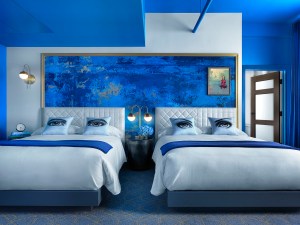
That one-of-a-kind hotel is being promoted as the first in the world where visitors can book a room by the mood they’re in. The rooms have four themes: tranquility, rejuvenation, happiness and passion. The themes are primarily manifested in color, with blue for tranquility, green for rejuvenation, yellow for happiness and red for passion. Smith is visibly excited when talking about the hotel, noting that while it may not be for everyone, everyone who visits it will have some sort of opinion on leaving.

“We’re going to have wonderful arts exhibits throughout the hotel, an incredible roof deck and a wonderful chef,” Smith says.

As for the future of Grand Center, Smith sees it progressing in growth and development as people continue to flock to the area.

“Grand Center is at an interesting point right now, because it was founded and formed to try to rebuild what was at the time a bunch of empty buildings and lots,” he says. “You drive there today, and there are no empty buildings. The next generation of Grand Center is going to be new construction and more housing for sure. Over the coming years, I see the district itself not only as a destination for the arts but also as a neighborhood where an increasing number of people live.”

In addition to introducing entirely new ideas to St. Louisans, Smith is passionate about preserving what’s been here for decades. He notes that one thing that sets St. Louis apart from cities like Nashville, Tennessee; Austin, Texas; or Charlotte, North Carolina, is its architectural heritage.

“One thing we’ve really been focusing on is taking historic treasures of St. Louis and rebirthing them,” he says. “When people come from out of town, they’re blown away by the quality of our architectural heritage. It’s a differentiator and I think it’s something St. Louis needs to more aggressively boast about.”

This story was originally published at laduenews.com. Read it on LN’s website here.

Ladue News Feature Stories

Bold As Brass

For decades, stainless steel and chrome finishes have dominated the design industry, leaving one of the formerly trendiest metals – brass – in the dust. Over the course of the past few years, however, brass has been making a slow and steady comeback, reasserting itself as a fun finish for everything from light fixtures to cabinet pulls.

Brass was a shiny staple in houses designed in the 1970s and ’80s, but the brass that’s making its way back into homes isn’t as bold as its popular predecessor 40 years ago. Instead, it’s being integrated in a matte finish, making a subdued statement on hardware and accessories across the country.

“People have tired of the stainless and brushed nickel trends,” says Kathleen Matthews, interior designer at Savvy Surrounding Style in Ladue. “The brass we are seeing today is a softer brass than before; most brass pieces are an unlacquered brass or a soft gold.”

Lauren Sweet-Schuler of Castle Design in Clayton believes brass is making a comeback because of its warm tones and how nicely it complements warm gray tones.

“I’m seeing it incorporated in many ways,” she says. “It starts in small doses and makes its way into every room.”

To reintroduce brass to your home, Sweet-Schuler recommends starting with a smaller space, like a powder room mirror or faucet hardware. Homeowners then can move on to bigger household components like a dining room chandelier. Sweet-Schuler also recommends mixing up its uses from room to room to keep it visually interesting.

“Maybe it’s hardware on a cabinet in one room and a large vase in another,” she says. “There are great ways to use it in any space.”

Matthews recommends keeping the finish subtle and staying away from the polished brass of the ’70s and ’80s to avoid a dated look. She encourages pairing today’s brass with jewel tones like a rich, dark green or a regal navy for a classic look. It can also be paired with marble in accent furniture pieces.

“The organic vibe of marble and the more industrial feel of brass can result in a dramatic cocktail table or dining room table,” she says.

Lisa Davis, visual merchandising specialist with KDR Designer Showrooms near Maryland Heights, suggests pairing brass with everything from acrylic to more natural elements.
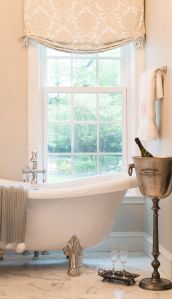

“My personal favorite is brass and acrylic, mixed together, or wood and brass for a more rustic but elegant feel,” she says.

Like Matthews and Sweet-Schuler, she’s seeing many clients starting to introduce brass into their lighting fixtures and home accessories.

“It’s an easy, inexpensive way to incorporate brass in any space, and a little goes a long way,” she says.

Although pendants and cabinet hardware reign as the most popular brass accessories right now, Matthews suggests a few unexpected ways to bring brass into your home. A modern bar cart? Yes, please.

“The finish makes the bar cart a little unexpected but also takes a functional accent piece to a new level,” she says. “A metallic brass finish is also being used in wall tiles. These tiles would make a dramatic and memorable backsplash in a residential bar area.”

Whether through subtle touches or dramatic elements, brass can be installed throughout the home as an eye-catching and striking design element. Its new matte appearance is making its way into brands across their entire line in modern, state-of-the-art pieces.

Sweet-Schuler advocates for the metal – but in a smart way.

“Brass is a finish often found in older homes,” she says, “so updating with the new matte brass finish still feels cohesive with exiting elements, while staying on-trend with the new warmer version.”

Only time will tell how long the fad continues its resurgence in the design world, but for now, designers like Matthews are enjoying its revival.

“Having been in design in the ’80s and ’90s, I was sorry to see [the brass trend] fade away,” Matthews says. “The resurgence of the unlacquered brass and gold tones is exciting! I encourage clients to add at least a few accents of brass to add an understated warmth.”

This story was originally published at laduenews.com. Read it on LN’s website here.

Ladue News Feature Stories

Bathroom Bliss

After a long day, wanting to come home to a sanctuarylike space is inevitable. For many, sinking into a warm bath with a book is as close to paradise as you can achieve on short notice. But maybe your master bath hasn’t been updated in 20 years, or it’s cluttered with everything from clothes to overflowing beauty products.

No matter your current master bath situation, you’re only a few steps away from creating the oasis you deserve. Local experts Jenny Rausch of Karr Bick Kitchen & Bath and Tanya Yaacoub with Mosby Building Arts both recommend starting off by talking to a designer about what your vision of a retreat looks like.

“It sounds simple, but the first step is finding out what ‘retreat/spa’ actually means or looks like to them,” Rausch says. “We get that request a lot, but it looks very different for everyone.”

Yaacoub says that for some, that definition could mean a big air tub (using jets of air instead of a whirlpool, which uses jets of water), a large shower with a seat and multiple heads, or a full steam shower. Popular options she’s seeing right now include freestanding air tubs with lights and aromatherapy, radiant heated floors, heated towel bars and zero-entry showers, which are flush with the bathroom floor. She’s also seeing an increase in trough vanity sinks or floated vanities, along with gorgeous open-shelf storage for towels. Yaacoub says clients are also seeking to choose the locations of the shower controls and how they function to create a truly personalized space.

Although the options available depend on the client’s budget, Rausch says she’s seeing an increased interest in heated flooring.

“It’s fairly simple to install, and it makes the most drastic impact on how the space feels,” she says. “Tile is interesting and bold and textural right now, but if you don’t heat it, it’s just cold!”

Rausch also recommends leaving space for a chair or some sort of bench, noting that the fabric and open-floor space can drastically increase an area’s spalike feel.

To create a relaxing environment with shades and hues, Rausch recommends soft, warm colors that subtly contrast. She notes that doing so showcases a look that’s cozy and clean. Yaacoub says she pulls colors into the design that are pleasing to the client – typically soft greens, blues and purples that can help homeowners reduce stress. In terms of textures, Yaacoub takes into account what will help improve the overall experience of the space.

“I like to mix a variety of textures to capitalize on the sensory experience,” Yaacoub says. “Maybe woodgrain tile on the floor with a gloss oversize subway wall tile and a honed- or suede-finish vanity top.”

As in a professional spa, lighting plays a huge role in a space’s environment and feel. To help create the most relaxing and soothing atmosphere, the designers highlight multiple kinds of lighting that can soften a space while preserving its functionality.

“A variety of ambient and task lighting is always desired for any functional space,” Yaacoub says. “For bathrooms, that is a variety of wall sconces and recessed canned lighting, all placed on dimmers, of course. With the addition of the LED [light-emitting diode] strip and tape lights, we can now even illuminate inside cabinetry, adding yet another level of lighting for this spa experience.”

Rausch has a simple philosophy when it comes to lighting: “Dimmers, dimmers, dimmers! Need I say more?”

Overall, creating a spalike master bath stems from the clients’ preferences and what is soothing and calming to them.

“If you like books and reading, create an area to display your favorite books,” Rausch says. “If your thing is music, make sure you build in a sound system. If the dog makes you feel better, make sure Fido has a nook with a spa bed, too.”

Yaacoub suggests perusing Houzz and Pinterest to gather concept ideas before taking the next step.

“Talk to your design professional, and don’t forget about audio,” she says. “Part of the spalike sensory experience is engaging all of the senses.”

No matter your budget or space, taking into account factors like color, lighting and the features that make you feel at peace can help create a spalike space that’s welcoming and serene after a rough day. Step into your sanctuary, and soak it up.

This story was originally published at laduenews.com. Read it on LN’s website here.

Ladue News Feature Stories

Hitting the Mark

Ellen Pendry had always been creative, but she never envisioned becoming a boutique owner.

Pendry had been teaching high school art for a few years before learning she was pregnant. Although a St. Louis native, she and her husband were living in Chicago, looking to return south. When he got a job and they moved back to St. Louis, Pendry was 34 weeks pregnant and knew trying to find a job at that point wouldn’t be logical with the baby’s impending arrival.

After their baby, Corinne, arrived in July 2015, Pendry found it difficult to be a stay-at-home mom with no creative outlet.

“I didn’t have a background in sewing or anything, but I just kind of went out on a limb,” Pendry says. “I wanted to make Corinne’s baptismal gown out of my wedding dress.”

She enlisted her mom (“who had made a thing or two for Halloween”) to help Pendry cut up her beloved wedding gown and was pleased with the results.

“After that, I realized how fun it was and wanted to make baby clothes to sell on Etsy,” she says.

And thus, Blue Mark Handmade was born. Pendry named the company after her very first sewing machine: a powder-blue Mark II from her grandmother. The name, to Pendry, contains the perfect amount of sentiment and professionalism.

Pendry, frustrated by the kids clothing market and its incessant sparkles and glitter, set out to craft a line that was more classic and sophisticated.

“I want my kids to wear kid versions of what I would wear,” she says. “That’s how I pick my fabrics.”

Comfort and fit were also key to Pendry’s initial efforts. As Corinne grew and after her brother, Wilson, arrived last October, the children’s mother realized the need for clothing that could be worn both to church and for play. Pendry wanted practical options – not something she’d spend too much money on only for her child to wear once. She works with knit organic fabrics in solid colors and florals, creating pieces like rompers, skirts, dresses and more.

“As far as pieces go, I will not sell anything I wouldn’t put on my own kid,” Pendry says. “These are pieces kids are comfortable being kids in.”

Some of her most popular items include twirl dresses (which Pendry says 3-year-old Corinne is obsessed with) along with peplums. All of her pieces are sold through her website and Etsy, where she has more than 200 five-star reviews.

“I’ve been humbled to hear such good things since starting Blue Mark,” Pendry says. “I hear from people that my clothing items are some of the best-quality handmade pieces they have.”

Since its inception in October 2016, Blue Mark Handmade has grown to fit each season. Right now, Pendry’s gearing up for her fall line, solely available on her website, which she’s excited to promote.

“I have the best fall colors,” she says. “I’m all about olive green, burgundy and warm, rich colors.”

She’ll be operating a bit differently this fall, though. Halfway through this summer, Pendry made the decision to switch from the made-to-order basis she was creating items from, to ready-to-ship pieces. She decided to make the switch to be able to stock up on pieces when she has time and focus on caring for her 3-year-old and 10-month-old.

Pendry moderates a VIP Facebook group for Blue Mark and has been receiving excited comments about her upcoming items. She says she’s been met with enthusiasm about the fall line’s bubble rompers with long sleeves – perfect for transitioning into autumn months.

As for the future, Pendry is looking to get her products into more stores and pursue wholesale endeavors. Blue Mark items aren’t currently available anywhere but online, but Pendry would love to be able to bring her pieces to local shops.

“It makes me feel good that I’m sending out good-quality clothes and that kids want to wear it because it’s comfy,” she says.

This story was originally published at laduenews.com. Read it on LN’s website here.

Ladue News Feature Stories

Fleur de Midtown

As a creative, Sarah-Marie Land is always seeking ways to express herself and support the things she loves. The artist, photographer and teacher is passionate about traveling, all things France – and shopping.

Land is always on the hunt for the best deals, and she eventually gathered a small collection of clothing items she wanted to turn around to a customer base. She began doing pop-ups around St. Louis under the name The Golden Fig – a name she and her sister had come up with.

“My sister and I were toying around with names and are passionate about almost all of the same things,” she says. “The golden fig just seems like this majestic, beautiful thing that you could go out and search for. I also like the symbolism of the fig: peace and prosperity.”

The pop-ups went well, and Land considered opening a small shop if she could find the right space. When she heard of a small midtown location across from Pappy’s Smokehouse on Olive Street, Land jumped at the chance.

“I really felt that I could do a lot with the space, even though it is very small,” she says. “I decided on a whim to go with it, even though I had recently found out I was pregnant.”

Land opened The Golden Fig last November and became a mom in December. Her shop is open Fridays and Saturdays (“mainly because of the baby”) and also by appointment.

Visitors to the creatively organized corner shop will first be met with an enticing aroma. Land realized the importance of a space’s scent after working a few holidays at Anthropologie in Richmond Heights and took inspiration from the well-known clothing retailer. The boutique’s walls are lined with clothing that ranges from classic colors to bright prints. Along with a curated selection of clothing items, Land also carries an array of shoes, handbags and other accessories

Drawing from her Francophile background, which includes numerous visits and a stint teaching English in Paris, Land stocks The Golden Fig with French brands that she grew to appreciate after living in France for a year and taking yearly trips there since. Visitors will find items by Jonak, Claudie Pierlot, Longchamp, Cop.Copine, Comptoir des Cotonniers and more. Along with the French influences, shop visitors will find familiar brands like J.Crew, Ralph Lauren, Kate Spade, Vera Wang and more.

“I really wanted to tie all my creative outlets into The Golden Fig,” Land says. “I go to France every summer, and there are so many brands there that I just lust over. I decided to have some unique brands you wouldn’t find elsewhere in St. Louis.”

The Golden Fig offers both new and what Land calls “pre-loved” pieces, born out of a passion for reusing and recycling clothing items instead of simply getting rid of them. She sources her inventory from all over – from department stores to online. Visitors to the shop will find new items every week.

“Resale shops are great because of the whole environmental factor of reusing and recycling what’s already out there,” she says. “I think often we dispose of things too quickly and go out and buy more. It’s important to reuse, and I don’t necessarily try to do what’s happening right this moment in the fashion world. There are pieces that are classic and always in style. I think I have a good eye with my creative background, tying into the curated sense of the shop and finding those unique pieces and how to set them up in the shop.”

In the months since the boutique’s opening, Land says she’s been getting great feedback from customers. Growth in her customer base has been increasing “slowly, but surely” as she looks to draw more visitors to St. Louis’ midtown.

“It’s been interesting with Pappy’s across the street and Chaifetz Arena nearby because I get a lot of customers from out of town,” she says. “I’m hoping more Saint Louis University students will come down. With more and more businesses coming into midtown, once it grows, people will come.”

Her goals for The Golden Fig are to increase traffic and continue to showcase brands customers perhaps haven’t seen before.

“[This store] is something I’m passionate about, and I love meeting people who come in,” she says. “Even if you think a resale shop isn’t for you, try it out. You might be surprised.”

This story was originally published at laduenews.com. Read it on LN’s website here.

Ladue News Feature Stories

A New Level of Design

Nick Adams is on a mission to push the design envelope in St. Louis.

The native St. Louisan has followed a lifelong passion for architecture and fabrication all over the country before landing back in his hometown – where he started his own company, Mademan Design.

Adams went to the University of Kansas, where his master’s program, Studio 804, turned into “one of the defining characteristics of my life.” During the program, Adams and 21 other students designed a house during their first semester. During the second semester, they built the home they’d designed: a modular home constructed in a warehouse in Lawrence, Kansas.
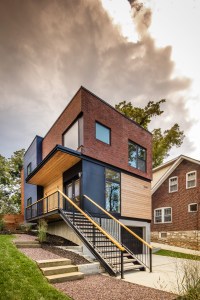

“We trucked in seven modules to Kansas City,” Adams recalls. “Most architects [in school] are doing watercolor and balsam wood models. We were actually hammering two-by-fours together.”

For some students, Studio 804 pushed them away from fabrication and architecture. But others, like Adams, were drawn to the design-build process even more. When he finished school, he came back to St. Louis and worked for SPACE Architecture + Design for five years.

Adams became restless, though, and had what he calls a “quarter-life crisis.” He loaded up his car and traveled westward to every major city he could see himself eventually moving to. Although the trip didn’t end in his moving, Adams discovered something important: He wanted to – and would – start his own company.

“If I started my own company, I could do work I felt was impactful,” he says. “I figured the best chance of success of pulling that off was if I came back to St. Louis, where I had a network of people.”

On returning to St. Louis, he picked up part-time work for SPACE again while he helped renovate a co-worker’s Tower Grove house.

“It was a mess, but it was great,” he says. “That started Mademan, though it wasn’t Mademan at that point. It was me trying to figure out how to generate work.”

His friend’s mother had a quartet of four-family homes that needed kitchens and bathrooms redone, so Adams took on those projects. Then, he left SPACE and worked for UIC/CDO for a few months before deciding it was time to commit to his own small client base full time.

When he turned his focus to what would become Mademan, all of Adams’ jobs were fabrication. Through a former SPACE co-worker, Adams learned about a workstation project at Mackey Mitchell Architects and put in a bid. He won the bid, opening up the door for other opportunities. He took on small furniture projects while studying for the Architect Registration Examination – needed to earn an architect license – and finally officially founded Mademan in early 2013. Through another lead, Adams secured his first substantial residential project, a modern Richmond Heights house.

“That project was a true labor of love,” he says. “These days, it probably takes us 200 hours to finish a residential project. This one was 450.”

The modern home took months of deliberation with the municipality, along with having to secure a new general contractor partway through the process. After editing $100,000 out of the initial general contractor’s budget, Adams and his small team created a sleek, modern, energy-efficient home that satisfied the clients’ wish list and budget.

“When it got complete, it opened up so many doors for us,” Adams says.

A passionate traveler, Adams relates seeing modern homebuilding all over the country, but hardly any of it here in St. Louis.

“When you travel outside of St. Louis, it’s easy to recognize how huge of an opportunity there is for some stuff out of the ordinary,” he says. “A lot of people looked at [the Richmond Heights project] and thought, ‘What a deviation!’ But this is the first step into making some awareness of doing modern architecture in a way that suits our city.”

Since then, the company has worked on projects of all shapes and sizes: from steel fabrication and design for Blueprint Coffee to cabinets for The Collective to a home at Dry Fork. Currently, Mademan is in the process of constructing two houses that are “kickass.” Adams and his team are also putting finishing touches on their work for Yellowbelly, a new restaurant project from the owners of Retreat Gastropub. (“We just need to deliver some steel, and it’s basically done.”)

Overall, Adams and his team want to continue to push the envelope and bring an architectural style that St. Louis doesn’t currently have.

“I didn’t start [Mademan] to find ourselves in the middle of the design world in terms of style,” he says.

Adams also hopes St. Louisans consider the option of modular construction: He’s pushing to change the delivery system of architecture and build big parts of houses under a roof before trucking them to a site, which ends up being more affordable.

Aside from a passion for modular and modern design, Adams is also a proponent for energy-efficient options.

“The Midwest is one of the hardest places to pull that off because of the hot, humid summer and the cold, dry winters,” he says. “It’s always an added cost for sustainable features. It’s more insulation, higher-efficiency furnaces, forced-air units, solar panels and geothermal. We’ve had success pushing the envelope in terms of design, but I’m hopeful to start implementing more sustainable features into those modern designs.”

This story was originally published at laduenews.com. Read it on LN’s website here.

Ladue News Feature Stories

Olive the Cuteness

Karen Hill is mom to three children under the age of 6. She has a 5-year-old son and 3-year-old fraternal twins. When her daughter was born, she became fascinated by the array of cute clothing available for little girls; however, she still felt inspired to craft some of her own.

“I’ve always been crafty,” Hill says. “I can’t even remember when I learned how to sew, but it’s been a long time. I remember learning cross-stitch when I was maybe 8 and making Christmas gifts for my family.”

Hill had attempted making clothing for herself years ago, but she found that “children’s clothes are much more fun and quicker to sew.” She soon filled her daughter’s closet with her homemade creations and knew something had to be done.

“There was only so much that a little person can wear in [his or her] life,” she says. “That’s when I started reaching out to make things for others.”
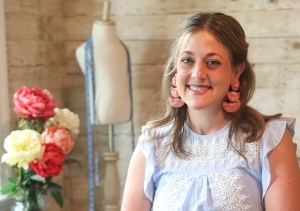
Hill started Olive + Peony in spring 2016. She named her children’s clothing business after two things that bring her joy.

“I picked ‘olive’ because my dream place to live is Italy, and the peony is one of my favorite flowers,” she says. “The name reminds me of things that are beautiful. I want to make things that are pretty and bring people joy.”

In her online store, customers will find a colorful array of little girls’ clothes. She specializes in the preschool to grade school range, which is usually sizes 2T to 6Y. As she’s been making more clothing, though, she’s grown in her sizes and has started making clothing on both ends of the spectrum, such as clothes for babies and preteens. Her homepage currently showcases three rompers with fun prints like poppy flowers and gingham. Flipping through the website’s options, visitors will find everything from tunics to petal shorts to skirts and even some boys’ clip-on bow ties and holiday belts.

“There are a lot of play clothes I like and a lot of dressy clothes I like on the market,” she says. “I try to have mine not too overly done … cute things that can be worn for every day. That’s the spot I try to hit.”

Hill says now is a great time to be a crafter because of all the fit-tested patterns available online.

“There are so many bountiful clothes designers with PDF patterns,” she says. “You can find almost anything you want. I’ll often splice things together, too.”

Hill does all the sewing herself and prewashes the clothes in a gentle detergent free of dyes and perfumes. She tries to use 100 percent cotton fabrics as much as possible. In addition to what’s available at oliveandpeony.com, Hill is constantly working on custom orders, as well.

“It’s funny because when I started doing this as a business, I said I’d do a ready-to-ship line,” she says. “Three kids in a year and a half doesn’t give you a lot of spare time. But now I laugh at that idea because my custom orders are half – if not more than half – of what I’ve been doing. It’s fun, though, because I get to do outfits for family photos or birthdays. It means a lot that they’ve chosen me to dress their kids for photos that’ll last forever.”

Repeat customers make up nearly half of her business, too, which has led Hill to develop lasting friendships with the parents who order the clothing for their kids. As a stay-at-home mom running a small business, she says she was surprised at how much she missed working in a professional environment and having that constant interaction with peers and co-workers.

“It’s been fun for me to have this as a way to still stay in touch with the outside world,” she says. “I’m so appreciative of everyone who’s been supportive of me.”

Going forward, Hill says she’d love to expand her boys’ section, calling that market “underserved.”

“It’s hard to do cute patterns for boys,” she says. “I would love to do more knit prints for babies, too. And more sibling sets.”

In the near future, Hill is excited to sell her wares at the Kirkwood Greentree Festival on Sept. 15 and 16.

“I haven’t done a lot of shows, but this will be a great chance for people to come by and see the pieces in person,” she says.

This story was originally published at laduenews.com. Read it on LN’s website here.

Ladue News Feature Stories

Sheer Brilliance

Beyond the door of a nondescript University City brick building lies an unimaginable amount of color – a resplendence, some might say.

Sucheta Bhide rented out the massive 8,000-square-foot warehouse last fall to house her growing high-gloss lacquer and painting company, The Resplendent Crow, where she reimagines furniture in a glamorous, Hollywood Regency style.

It all started in 2013, when Bhide bought a little house in Maryland Heights and was looking for a high-gloss accent table. When she had little luck finding anything locally, she decided to research how to create the look herself. She was so pleased with the results that she did a few more pieces in her house, including a dresser.

“After a while, I realized I only had so big of a house and decided to start selling [the furniture],” she says.
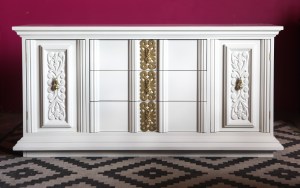
Bhide set about finding a name for her new venture, knowing she wanted a word that would describe the rich, colorful tones she was using to reimagine the pieces. Since she loves birds and used to enjoy painting them, her then-boyfriend suggested looking to feathered friends for inspiration. Bhide started researching colorful birds and stumbled across the resplendent quetzal, a Central American bird of stunning green and red.

“I knew the word ‘resplendent’ was exactly what I was looking for,” she says.

But she also wanted a not-so-serious, slightly oxymoronic feel to the name, so she tacked on the word “crow.”

“There [are] times when I feel like even though my furniture is resplendent, I’m here with my hair in a bun and covered in paint,” she says. “So I’m kind of like the crow.”

Kicking off her new venture, Bhide painted a set she had found on Craigslist and put it on Etsy. When someone from Wyoming purchased it, she realized it wasn’t just local St. Louisans who were looking for this unique glam look – it was folks from all over the country. To accommodate her growing business, Bhide knew she had to expand out of her house.

“I was doing it in my garage for a year or so, and it got so cramped,” she says. “The house would smell like paint all the time.”

Bhide started with a 1,000-square-foot warehouse on Olive Boulevard, thinking that space would be plenty.

“I outgrew it in two months,” she says. “This kind of business just needs a huge amount of storage space.”

She continued to work out of the warehouse for two years until she found her current space on Maple Avenue. The two-story building houses all the pieces that are either finished or ready for customization on the second floor, while all of the work takes place on the main level.

Although a large portion of her business consists of customers bringing in pieces to be painted, she also offers pieces that she’s sought out from all over the country. When a customer has a dresser he or she wants customized, for example, The Resplendent Crow arranges for pickup. When the piece makes it to the warehouse, Bhide and her six team members take it apart, setting the hardware aside. They sand the piece down, scuffing the surface up enough to the point where it can easily be primed. After a few coats of primer, they fix any dings and imperfections with filler. From there, the piece receives three to five coats of lacquer. Gloss finishes are what The Resplendent Crow is known for, but Bhide and her team can also do satin and matte sheens on pieces. The process takes about three to four weeks, and the finished pieces sell for an average of approximately $1,500.

Bhide sends dressers, credenzas, chairs, desks, nightstands and more out all over the country. In a tour of her facility, she pointed out pieces that were going to California, Oklahoma, Maryland and New Jersey. One piece is even in the works to go to Hawaii.

Although she can match any color for paint, there’s one in particular that’s remained popular among her sold pieces.

“I never would’ve guessed, but I sell hot pink furniture all day long,” she says. “I think people see the colors I’ve used on social media, and they finally feel brave enough to make the jump.”

Bhide’s goal with The Resplendent Crow is to continue selling and customizing furniture, in the hopes of eventually opening a retail location. She believes it would be easier to show off the eclectic mix-and-match look people are going for in a shop-type location.

“As much as I like this space right now, it’s still a warehouse setup, and it’s hard for people to imagine the pieces in their own spaces,” she says.

Since she began her business, Bhide has been met overwhelmingly with support from her customers and suggests those interested get to know her work better by following The Resplendent Crow’s Instagram or Facebook page and also visit her Etsy shop.

“People love that they can get their old pieces of furniture customized,” she says. “They’ve come to appreciate vintage and older pieces. They’re thrilled with the transformations, especially if it’s a piece that’s theirs that they really love.”

This story was originally published at laduenews.com. Read it on LN’s website here.