Ladue News Feature Stories

Beary Tasty

On Nov. 14, a colorful new storefront made its debut in Des Peres’ West County Center: Build-A-Bear Bakeshop.

Inspired by the company’s deep-rooted make-your-own concept, the bakeshop brings a new approach that goes beyond creating a plush pal. At the first-ever Build-A-Bear Bakeshop, customers of all ages can decorate their own cupcakes, provided by locally owned sweet treat company Sarah’s Cake Shop.

According to chief operating officer Chris Hurt, Build-A-Bear actually introduced a food concept in the early 2000s – the Eat with Your Bear Hands single-location restaurant was launched in 2005 to complement the in-store experience at the Fifth Avenue store in New York City. The restaurant closed in 2007, but the company’s 20th birthday was the perfect excuse to bring back a sweet element of the concept in a smaller format with Build-A-Bear Bakeshop. By chance, a space became available on West County Center’s first floor, just a few storefronts down from the mall’s Build-A-Bear Workshop.

“We couldn’t have asked for a better time to open a concept like this,” Louis Wachter, the chief bakeshop manager, says, eyeing the busy mall around him. “The traffic has been unreal, and [the storefront] is so bright compared to those around it. Your eyes just go right to it.”

Patrons to West County Center can enjoy a variety of sweet treats including cupcakes, cake pops, cookies, cakes, macarons and more. Individual treats start at $2, and a 6-inch cake is $17.50. Customers can choose from already-iced cakes and treats or choose to decorate their own cupcakes with frosting, icing pens and sprinkles. The store also has a deal where customers can get two cupcakes and a drink – choosing from juice, milk, coffee or water – for $9, which Wachter says has been “hugely popular.” In addition to walk-in items, customers can also schedule a party at the bakeshop, where a “party host” will lead the group through decorating their cupcakes in a reserved place for games and activities. In the deluxe decorator package, each guest will receive a child-size apron and a character appearance in addition to the components of the basic decorator package.

Paired with their bakeshop goody, customers can also choose from a selection of milk from Kansas City’s famed Shatto Milk Company that include chocolate, strawberry, cotton candy and root beer flavors.

“We heard Shatto Milk was a big deal, so we gave them a call,” Wachter says. “They agreed to partner with us, and it marked their first venture out of the Kansas City area.”

When the bakeshop first opened, there was a line out the door just for the milk. Wachter recalls people leaving with multiple bottles of the cotton candy milk. “It’s been crazy,” he says.

Aside from branching out a bit to the other side of Missouri, working with local and regional companies has also been important to Build-A-Bear in bringing the bakeshop to life. Right out of the gate, the shop teamed with Sarah’s Cake Shop, whose team brings baked goods to the store three days a week. The bakeshop also carries St. Louis-based Dubuque Coffee and a variety of merchandise items themed around the bakeshop like mugs, thermoses and water bottles.

For now, the West County Center location of the bakeshop is the original and only store open for the Build-A-Bear brand.

“The Build-A-Bear name has been helpful to the success and the aesthetic so far,” Wachter says. “But it’s different from what people are used to.”

Though the bakeshop isn’t physically connected to the mall’s Build-A-Bear Workshop, Wachter has observed a notable stream of traffic to the bakeshop seems to come from customers who have previously been at the store creating furry friends.

“People know we’re here and are figuring time at the bakeshop into their winter plans,” he says.

Wachter recalls the “warm, fuzzy feeling” he had when he first started working in the workshop and is always seeking to provide that for countless customers to the bakeshop. He wants the bakeshop to be a place of fun, memories – and lots of sprinkles.

“A lot of kids spend the holidays baking with mom or grandma, but they [might] only see grandma a few times a year,” Wachter says. “If they come in here and decorate, they’ll have that moment and that memory, and Build-A-Bear can be part of that experience. Kids love the creative side, and we’ll handle the mess.”

This story was originally published at laduenews.com. Read it on LN’s website here.
Ladue News Feature Stories

Fore the Fiercely Feminine

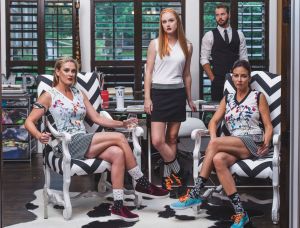
Kim Tuttle, Kari Schindehette and Jacque Bardgett love everything about golf – almost.

Sisters Tuttle and Schindehette and Tuttle’s stepdaughter, Bardgett, found themselves frustrated with women’s golf clothing every time they hit the links. They disliked the shapeless shirts and boring skorts that dominate the market. They wanted something more for their golf attire – something fresh, fierce and feminine.

“The clothes are just always lacking,” Tuttle says. “They never had any style.”

Frustration turned into brainstorming, which turned into the formation of a plan. “We decided this was something we wanted to pursue,” Tuttle says.

The sisters note that now is a great time to pursue this mission for better women’s golf clothing, citing a big push in the golf industry for more women golfers. Although many companies are manufacturing women’s golf clothing, Schindehette says it all looks the same. They wanted to create a line both edgy and modern that women would want to wear both on and off the course.

And so, Motherputter was born.

The three local women worked with a public relations company to come up with names, and as soon as they saw “Motherputter,” they knew “that was it.”

“It has a bit of a rebel vibe,” Schindehette says. “It sounds kind of crazy, but once we got the branding figured out, everything gelled around that.”

Tuttle’s background is in fashion merchandising, and she says working with Motherputter truly takes her back to her roots.

“It’s not just another line of golf clothes,” she says. “We have this vision to create a community for women golfers. We want to bring them together to grow, teach and learn.”

Schindehette says golf has always historically been a men’s sport, but adds that trends show women spending more at pro shops. They hope to get their brand into retail shops, pro shops and specialty stores. Luckily, with a snappy name like Motherputter, Schindehette says that “everybody wants to be part of it.”

They officially launched Motherputter in November 2017 at the Ladies’ Fall Boutique at Meadowbrook Country Club in Ballwin and have continued online sales since. On Jan. 8, they launched the line at Naples Grande Golf Club in Naples, Florida.

The inaugural line from Motherputter consists of funky sleeveless tops, a reversible zip-up vest, a Motherputter signature polo, skorts, shorts and dresses. The trendy golf apparel is all made in the United States and is made of performance-quality fabrics that breathe and move with a body in motion.

“One of the first things we designed was our Sweetwater dress,” Tuttle says. “Golf dresses are a fairly new concept, and we’ve done a different take on it.”

With a dropped waistline, edgy stripe in the back, checked design on the front and a floral top, the Sweetwater dress has been one of the company’s best-sellers since online sales opened. Another best-seller is the Motherputter signature polo; the black polo features a white collar, big-hole mesh sleeves and branded elastic, along with a branded zipper pull.

“We’re trying to break the trends from the old, stodgy men’s styles,” Schindehette says.

Tuttle notes that Motherputter is more than just clothes – it’s an attitude. The clothing pieces are designed with all ages in mind, working to bolster that sense of inclusivity and community the team is going for.

Going forward, the Motherputter team is working hard on its online and social media presence. With goals to grow the community and bring women together in femininity and individuality, the ladies of Motherputter have their sights set high.

“Our mission is to empower women,” Schindehette says. “Golf is such a mentally tough game, but it’s all about confidence. If you look good and feel good, your game is better.”

This story was originally published at laduenews.com. Read it on LN’s website here.

Ladue News Feature Stories

Bringing Sunshine and Joy

It was summer 2014, and David Fissell’s wife, Gloria, had been in and out of more than one nursing home. A few weeks before she passed away, she had a talk with her husband of 30-plus years about what his life would be like after her passing.

“She asked me, ‘What are you going to do after I pass away, sweetie?’” he says. “She said, ‘Do you know how many people here tell me how lucky I am to have you?’”

When Gloria Fissell was in the nursing homes, David Fissell hardly ever left her side, staying from breakfast until after supper and helping other residents while she napped. In fact, he was voted employee of the month twice because of his caring efforts and assistance. Gloria Fissell had noticed that many nursing home residents rarely or never had visitors and wanted her husband to do something for those in need after she was gone.

Gloria Fissell died at 80 years old on July 26, 2014. She left her husband a $1,000 stash in their home that he was to use to improve the lives of area nursing home residents.

“I started out trying to help [people on] Medicaid, especially those who didn’t have families,” he says. “After several trips to nursing homes, I found that even residents with traditional insurance or living family members usually had it just as bad.”

Fissell started off helping out at Mount Carmel Senior Living in St. Charles and got involved with bingo, something he says brings real joy to the facility’s residents. They call him “the bingo man.”

“Most people don’t want their relatives or loved ones to go into a nursing home,” Lisa Owen, executive director of the David & Gloria Fissell Foundation, says. “Individuals also don’t want to think about nursing homes, in general, and what may go on there because we’ve all heard stories or seen news reports. It’s challenging for the foundation to find volunteers willing to go into facilities because of the fear and stigma attached to such places. For many individuals, folks in nursing homes are kind of ‘out of sight, out of mind’ – people don’t want to think about it.”

Fissell made the decision in 2016 to start the David & Gloria Fissell Foundation, a nonprofit organization headquartered in St. Charles. The foundation currently serves five St. Charles County nursing homes and assisted living facilities, encompassing more than 500 residents and welcomes volunteers to bake treats, read to residents and play games with the elderly.

The foundation’s goal is to “put smiles on faces every day” and improve the lives of the residents at these facilities by providing items that bring joy and comfort, such as handmade fleece blankets, baked goods, snacks and treats, crossword and word-search puzzle books, and cards, gifts and decorations for holidays and special occasions, such as birthdays, resident appreciation days and ice cream socials. Just weeks ago, residents at the O’Fallon Mount Carmel Senior Living facility celebrated the season at a party that included gifts, carolers, festive décor and holiday candy.

Fissell now plays bingo every day of the week across four different facilities, which costs the foundation between $450 and $550 a month.

Owen explains that bingo is “really meaningful” for the residents. “The games are a wonderful opportunity for seniors to get out of their rooms, make friends, socialize with other folks and engage in a purposeful activity,” she says. “This helps them get a little exercise, use fine motor skills and keep their brains sharp. In addition, residents know that Dave and the foundation he represents truly care and are looking out for them.

“One item that’s extremely special to our residents are the blankets we make and distribute. You can’t imagine how much comfort our warm, soft and cuddly homemade fleece tie blankets bring to lonely seniors and disabled folks in the care centers and rehab facilities we serve!”

Fissell says Gloria is his guardian angel and continues to watch over him as he works tirelessly to bring some joy to the lives of area nursing home residents.

“We were married over 30 years,” he recalls fondly. “I was her third husband, and she was my fourth wife, but we were together longer than all the other ones added up. She was my soulmate.”

This story was originally published at laduenews.com. Read it on LN’s website here.

Ladue News Feature Stories

Telling St. Louis Stories

Jim Kirchherr didn’t always want to work in media. In fact, when he was at the University of Illinois Urbana-Champaign, he was studying history with plans to be a social studies teacher. But the now-senior director of content at Nine Network made a “spur of the moment” decision to switch to broadcast. “It was never something I was dreaming about,” he says. “I’ve just always been good with words.”

His way with words didn’t lead him astray. Kirchherr went on to have a successful career in media, including 27 years with St. Louis’ Nine Network. At the end of November, Kirchherr learned he would be inducted into the 2018 class of the Media Hall of Fame for his work with the local public television station on countless broadcasts, digital content, documentaries, public affairs specials and more. He’s won 26 regional Emmy awards, most recently for his work on a program about a Washington University in St. Louis laboratory that was studying the abilities of swarms of cyborg locusts to use their antennae to sniff out explosives.

“[The Hall of Fame induction] is a recognition of a very steady output of really good work,” he says. “When you work in public TV, people appreciate that, but you often don’t get a lot of recognition. This is kind of nice.”
When asked about memorable career highlights and milestones, Kirchherr harks back to his first TV job, which showed him he was in fact cut out for the career ahead. It was Dec. 13, 1977, and a plane carrying the University of Evansville Aces basketball team crashed on takeoff, killing all 29 passengers.

“That was the first national story I covered, and it was important to me because I realized how well I could work under pressure and try to organize a newscast on short notice,” he says. “It was an important revelation for a terrible story.”

Kirchherr has been at Nine Network since 1991 and has worked on numerous projects he calls to mind as memorable. At the turn of the century, he produced a nine-part history series called Decades: St. Louis in the 20th Century, which he notes he is particularly proud of. Kirchherr also notes Homeland: Immigration in America as another career highlight – Kirchherr served as a producer and writer on the three-hour documentary series that explored America’s immigrant experience and aired nationally during the 2012 election.

Although he grew up in Chicago and moved to St. Louis in 1978, Kirchherr says his “outsider” lens gives him a new view of the city that born-and-raised residents don’t have.

“Not being born and raised here gives you a different perspective because you tend to notice things that people who grew up here don’t notice,” he says. “Almost anything I notice on the street that catches my eye is something I’m curious about and want to know what the story is.”

This curiosity often leads to stories that unveil parts of St. Louis residents would’ve never otherwise known.

“My favorite thing to hear from people after they’ve seen something I’ve done is ‘I’ve lived here all my life, and I never knew that,’” Kirchherr says.

Although sometimes they’re not “earthshaking” things, Kirchherr says this fresh perspective has led him to do things like climb the inside of the Union Station clock tower.

“I’ve driven by that a million times,” he says. “One day I wondered if they’d let me climb it. It took some negotiating, but we took a camera and did it.”

Kirchherr calls St. Louis a well-kept secret in many aspects and summons a quote from writer Theodore Dreiser to describe how he feels about the city. “I learned in time to like it very much, but for the things that set it apart from other cities, not for the things by which it sought to rival them,” the quote goes.

“I think that’s both praiseworthy and somewhat indicative of St. Louis not tooting its horn as much as it should,” he says. “St. Louis could really play to its strengths.”

In his work with the Nine Network, Kirchherr has been able to dig into St. Louis’ strengths and weaknesses alike. He says the most gratifying part of his job is the ability to find and tell stories across the region in a way that’s comprehensive and thoughtful.

“It’s given me the opportunity to do research, to dig into the past, to cover current issues … and do it all well,” he says. “With public television, we have the airtime to do these stories well.”

Where other networks might have only a minute to tell a particular story, public television allows producers like Kirchherr the airtime to delve deep into their topics and really tell the story.

“The challenge for public TV is always funding,” he says. “Changing technologies can be viewed as an obstacle or an opportunity. I think if Nine Network remains a valuable resource, the quality of content is always going to be a top priority, not necessarily the tools.”

This story was originally published at laduenews.com. Read it on LN’s website here.

Ladue News Feature Stories

With Open Minds – and Open Hearts

“Love your neighbor as yourself.”

For Lucas Rouggly, this oft-heard commandment is a complete way of life. He and his wife made the decision to move their family to north St. Louis to truly understand the needs of the northern part of the city and be able to help those around them.

“When we made the leap [to move from Portland, Oregon], we had a lot of friends and family that were excited for us and wanted to help out, too,” Rouggly says.
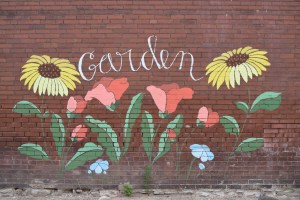
Thus, LOVEtheLOU was born. The nonprofit was formed to take the pulse of the needs of city neighbors and how the needs can be met through loving relationships. In its early days, Rouggly, his family and friends hosted block parties and street festivals in the municipality’s Old North St. Louis neighborhood. These activities proved to be an easy way to combine people wanting to serve and people wanting to celebrate. After they turned a vacant lot into a garden, though, “everything just snowballed.” They started their work in 2010 and received their status as a nonprofit organization in 2014.

“Over the past three or so years, we’ve had more than 1,000 volunteers come and help out [in the gardens],” Rouggly says.

With growing support from volunteers and partners, the community development initiative has expanded significantly in more ways than one.

After being given a building two years ago, volunteers of LOVEtheLOU rehabilitated 10 apartments in the space, which are being rented out to north St. Louis residents at the lowest prices in their area of the city. There are four business spaces in the building, as well, creating a marketplace for local entrepreneurs.

In addition to the physical strides LOVEtheLOU has been making in north St. Louis, the group has been consistently working to form relationships with the people who live there. In 2015, the group started a mentorship program with teens specifically, called STL | LIFT. It brought on two youth directors to work with the teens of North City, employing the teens over the summer to work in the three community gardens while showing them new opportunities outside of the area they reside.

“We took 26 [teens] this summer, and they did absolutely phenomenal,” Rouggly says. “It’s a testament to a little bit of love.”

Each week, the LOVEtheLOU team takes the teens on an “empowered experience” after their work in the community gardens to expose the students to different career paths and opportunities. LOVEtheLOU also partners with businesses to do everything from horseback riding to showing students how to get their driver licenses to doing financial planning and budgeting – important, and sometimes fun, life lessons they might otherwise not learn.

Rouggly says it’s often surprising how quickly the teens change when given opportunities and a little bit of love. Rouggly described one student as “completely out of line” the first time they took him out to a camp; however, by the end of the summer, “he was a completely different kid.”

“His whole demeanor changed,” Rouggly says. “He was asking question after question. The only thing that was different was that he had people surrounding him, giving him opportunities and love.”

Realistically, Rouggly knows the LOVEtheLOU team won’t reach all the kids in St. Louis. But each year, they hope to grow their mentorship program.

“The goal is to take every one of the kids and give them 100 different experiences they wouldn’t receive otherwise,” he says. “In doing that, we’re expecting a high percentage of them to be completely transformed. This isn’t just tutoring or a program after school; it’s a holistic approach to every part of life. That’s where we find our niche. We want to really walk with these kids and allow our huge volunteer base to walk with them, as well.”

LOVEtheLOU’s projects also include facets called STL | LINK, which will partner LOVEtheLOU with businesses and other nonprofits to work together on common goals, and STL | LIVE, which is the nonprofit’s biggest initiative for 2018. STL | LIVE will work with outside groups like area churches in St. Louis County and plug them into fixing up abandoned houses. Once the homes are rehabilitated, Rouggly and his crew have identified individuals in the area who will be selected for home ownership.
“They won’t be renting – they’ll actually be owning these homes,” Rouggly says. “It’ll be a process of taking vacancies, fixing them up and handing them over to people who are well-deserving.”

For the long-term future, Rouggly and his team want to “give as much away as possible.” With a solid volunteer base, LOVEtheLOU will be working to find city residents who can benefit from groups coming in and being in their neighborhoods.

“We help give people a vision of what can be,” he says. “We don’t have to be a flyover city in peoples’ minds. There’s so much good here. It’s going to take organizations like LOVEtheLOU to highlight the good and point it out. The word ‘love’ for us isn’t cliché – it’s backed with action.”

This story was originally published at laduenews.com. Read it on LN’s website here.

Ladue News Feature Stories

Ferguson Community Empowerment Center Builds a Beacon of Hope

In August 2014, the city of Ferguson was thrown into the global spotlight after the fatal shooting of Michael Brown by police officer Darren Wilson. In the days that followed the Aug. 9 shooting, a QuikTrip on West Florissant Avenue was looted and burned to the ground during a riot followed by an evening of otherwise peaceful protesting.

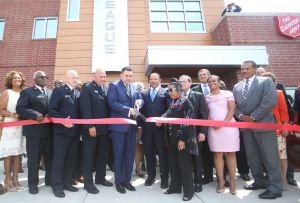
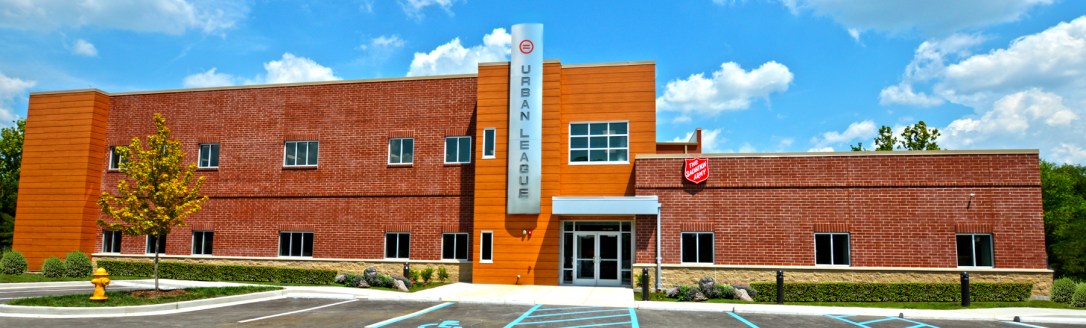
Three years later, the site of the burned-out QuikTrip is unrecognizable from what it was following then. In its place stands a state-of-the-art, multimillion-dollar facility that houses offices for the Urban League of Metropolitan St. Louis, The Salvation Army’s Midland Chapter, University of Missouri Extension and Lutheran Hope Center.

At the end of July, coinciding with the National Urban League’s annual conference taking place in St. Louis, the Ferguson Community Empowerment Center opened its doors at 9420 W. Florissant Ave. Michael McMillan, the president of the local Urban League chapter, says the center has been met with a “fantastic response” from the community in the months since its opening. Much of the interest has come from walk-in traffic, he notes, with residents of the surrounding communities curious about the resources offered at the center.

One such resource is the Save Our Sons program, which was started as a direct result of the unrest in Ferguson in 2014. McMillan, who was named president of the Urban League’s local chapter in 2013, recalls the huge outcry from young people wanting their voices to be heard.

“Usually, decision-making tables consist of people who have risen in their careers to a certain level,” he says. “As a result, a lot of times you don’t have young people in the room when decisions are being made. We made a conscious choice to get out into the community and literally walk these streets to listen to what young people needed to say.”

Though the young people of the North County community expressed a variety of opinions, one thing that was overwhelmingly stressed was the need for jobs. Urban League members looked at their statistics and found that 70 percent of their clients were female heads of households. Men, they discovered, largely weren’t taking advantage of programs.

“We wanted to tailor a program just centered around them, because African-American males in North County and north St. Louis City have three times the unemployment rate of the average citizen,” McMillan says. “We wanted to make sure we did something to rectify that and deal with it as a crisis. We created Save Our Sons, working on our federal workforce model we’ve had for the past 16 years.”
Save Our Sons is a four-week program that focuses on how to get a job, how to keep a job, how to get promoted and how to become more marketable in the workplace. It’s the Urban League’s goal to place graduates of the program in new jobs.

“We don’t consider it a success until we place you somewhere,” McMillan says. “We have hiring managers and human-resource officers come in from around the region with more than 100 partner companies we work with.”

The Urban League also takes into account the candidates’ interests, working to place them in jobs that they enjoy – something beneficial for both the employer and the employee. To date, Save Our Sons has graduated 400 men and placed them in jobs in warehousing, logistics, shipping, retail, food service, construction, information technology, and parks and conservation. As the program continues to develop and expand, McMillan hopes it can be used as a model across the region and even across the country.

“There’s significant need to expand it into the city, to East St. Louis and St. Clair County,” McMillan says. “This is an epidemic all over the country, and we’d love to have [the program model] utilized everywhere. In the Urban League movement with almost 100 [chapters] across the country, we’re constantly trying to show best practices and learn from each other.”

The Ferguson Community Empowerment Center is truly a collaborative effort. Construction for the $5.8 million building was paid in full, with funding from donors, St. Louis County tax credits, co-owner The Salvation Army and TIAA Direct. University of Missouri-St. Louis’ extension program operates a satellite office out of the building, and Lutheran Hope Center also has offices there. Other organizations, like Better Family Life and Provident, will be able to use the building for events.

“We’re most proud of the fact that there’s been so much overwhelming support from everyone we asked to be a part of this in any way whatsoever,” McMillan says. “Every part of society here has been so supportive, and we couldn’t be happier.”

As for the center’s future, McMillan hopes tens of thousands of people will be able to come through its doors to get services and build better lives for themselves and the community around them.

“We want to constantly promote the spirit of giving back,” he says. “No matter a person’s circumstance, we hope they would use the gifts they’ve been given to give of their time to help others and that this building would be a beacon of that – of helping others and making a difference in the community.”

This story was originally published at laduenews.com. Read it on LN’s website here.

Ladue News Feature Stories

A Helping Hand for Those Who Gave All

From 2004 to 2005, Dustin Row served in the Iraq War with the 724th Transportation Unit of Bartonville, Illinois. The unit’s mission was to escort fuel convoys to Baghdad and western Iraq. On April 9, 2004, the unit drove a support convoy directly into an ongoing offensive between the U.S. Army and Shiite militiamen. Outnumbered by hundreds, Row’s truck was one out of six to make it through the kill zone. Two of his fellow soldiers were killed in action, and one was captured.
When he returned to his hometown of Columbia, Illinois (just 20 minutes from downtown St. Louis), he had a good job and a supportive family. He knew these were luxuries that many combat veterans aren’t afforded and felt compelled to do something about it. In 2013, he started a not-for-profit organization called Songs4Soldiers to help returning combat veterans and their families. As a fundraiser for the organization, Row assembled his band, Where’s Charlie?, and other local groups to perform a benefit concert in a grocery store parking lot in Columbia.

What started small has grown tremendously in the past four years. In 2013, the organization was able to put close to $7,000 toward veterans assistance. In 2016 alone, that number was up to more than $155,000.

“We have a huge concert every year, and 100 percent of the proceeds help combat veterans all across the Midwest throughout the entire year,” Row says. “Up to this point, we’ve spent more than $325,000 and helped more than 245 combat veterans and their families.”

When it comes to helping veterans, Songs4Soldiers has a unique way of making sure the money goes to the right places.

“We’ve never given a dollar of cash to any veteran, ever,” Row says. “Whatever their greatest need might be, we do it directly. That way we know for a fact it goes to the right place.”

Songs4Soldiers only helps veterans who are “doing their best to put their best foot forward,” Row says. All too often, help for veterans is nothing more than a Band-Aid of sorts, he explains. To combat that, Songs4Soldiers aids in funding mortgages, security deposits, dental work, home repairs, support dogs and more.

“If you can name it, we’ve done it,” Row says.

The yearly concert is the organization’s biggest fundraiser, with last September’s raising more than $91,000. It’s caught the attention of veterans and media outlets across the Midwest and continues to grow with each passing year.

With growth comes challenge, though. As a town of 10,000, some question if Columbia has the space to support an event this big. Row thinks so – he says Songs4Soldiers’ annual concert will always be held in Columbia. However, out of necessity, it’s grown to a two-night event this year with a national performer headlining the event.

On Sept. 22, Columbia’s Bolm-Schuhkraft City Park will host singer/songwriter Bret Michaels, along with local acts Jeremiah Johnson Band and Dazed n Confused STL. On the concert’s second day, Sept. 23, the lineup will feature ClusterPluck, The Dave Glover Band, PettyCash Junction, Where’s Charlie?, Dazed n Confused STL, Joe Dirt and the Dirty Boys, and SuperJam. The second day will also feature a kid zone with bounce houses, although both days are family-friendly, Row says.

“The cool thing about doing a two-night show for the first time is that it doesn’t come from a place of ego – we literally need to have a second show to support the number of veterans that we have coming in from all over the Midwest,” he says. “We have combat vets coming from St. Louis, Chicago, Tennessee, Michigan … the whole Midwest.”

When asked what he’s looking forward to the most about this year’s event, Row says the answer is twofold. The first part is a surprise, though, and will take place during the Bret Michaels show on the concert’s first night. The second part is something that happens every year: his chance to look out at the crowd from the side of the stage and just take it all in.

“Looking at my team and my kids and seeing how far this has come is my favorite moment every year,” he says. “It’s not just a normal concert. It’s allowing us to help hundreds of people. It’s like Christmas morning to me.”

Row has high hopes for the future of Songs4Soldiers. He envisions continued growth as word spreads but wants the organization to remain “very small at heart.”

“I picture a national charity coming out of an awesome, supportive community,” he says. “The original mission of Songs4Soldiers was to be a small show and help four combat veterans a year, so I’d say we’re onto something here.”

Songs4Soldiers Fifth Annual Benefit Concert

What: A two-day concert series to benefit combat veterans across the Midwest and their families

When: Friday, Sept. 22, and Saturday, Sept. 23

Where: Bolm-Schuhkraft City Park, Columbia, Illinois

Details: Friday admission, $30 in advance, $35 at the door; Saturday admission, $10 in advance, $15 at the door; veterans and kids ages 12 and under, free

Information: songs4soldiersstl.org

This story was originally published at laduenews.com. Read it on LN’s website here.

Ladue News Feature Stories

A Talk with the Minister of Silly Walks

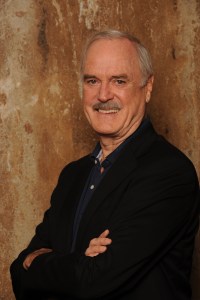
photo courtesy of John Cleese

On Tue., Jan. 24, the man who established The Ministry of Silly Walks took the stage at Powell Hall as part of the St. Louis Speaker Series presented by Maryville University. John Cleese is best known for his work with the legendary Monty Python comedy troupe – including fan-favorite films Monty Python’s Life of Brian and Monty Python’s The Meaning of Life – as well as BBC sitcom Fawlty Towers and A Fish Called Wanda, a film he co-wrote and starred in alongside Jamie Lee Curtis and Kevin Kline.

In late 2014, he released his best-selling memoir, So, Anyway…, which details his early life and how he first broke into the world of comedy. Cleese is currently on an American tour in support of the book, including speaking engagements like the one at Powell Hall, as well as making appearances at screenings of Monty Python and the Holy Grail.

LN had a chance to catch up with Cleese just before his appearance at Powell Hall to learn about his memoir, how he’s seen comedy evolve in the past five decades and what he has planned for 2017 and beyond.

What has your U.S. tour been like so far?

It’s been quite hard work, but very enjoyable. The shows themselves have been terrific, with wonderful audiences. They’re great, particularly the Holy Grail audiences. When I walk out, there’s a great deal of warmth and affection. They have my sense of humor. A couple of days ago, we traveled for seven hours and then did a show at the end of it. If you do a couple of those in a row, it’s very tiring. We’re doing Worcester, Mass., tonight [Fri., Jan. 20], which will be the eighth show in eight days, and then we fly to Chicago for a day off, which feels like a week off!

What was your writing process like for So, Anyway…?

It was extraordinarily enjoyable, and I didn’t know whether it was going to be or not. I know one famous British film star who started writing his autobiography and found it was so emotionally painful to go through and relive some things that he stopped writing. I had the opposite response, probably because I’ve had so much therapy over the years, so I feel like I’ve worked through most of those things. When I was able to look back on those moments when I’d been very upset, I remember how I felt at the time, but I was no longer influenced by it emotionally and was able to watch it from sort of a distance.

Are you planning on writing more in the future?

Yes, I’m going to write another [book] … when I get some time!

What’s your favorite thing about Americans and being in America?

I think the friendliness is my favorite thing about Americans. The people in hotels are always so friendly and want to do their best. I also think [there are] some really good newspapers here, and we don’t have that in England. I love reading The New York Times, The Washington Post and The Boston Globe.

Do you think American attitudes toward British comedy have changed in the past few decades?

I don’t think so, no. So far as British comedy films are concerned, it’s pretty rare to get a breakthrough. But I think so far as television is concerned, a lot of Americans, particularly the older ones, would say they’d rather watch old English comedy than old American comedy. I think we’ve always liked each other’s comedy.

Do you think Monty Python and the Holy Grail would be popular if it were released today?

Yes, I do. I don’t see any reason why it shouldn’t be. I think we’d have much more trouble with Life of Brian [if it were released today], but it’s hard to tell. There were protests in New York when we showed Life of Brian in 1979. People were carrying placards saying, “Monty Python is the agent of the devil.” In fact, they did our publicity for us. They made us news every day for a week!

What are you most proud of in your career?

I think Fawlty Towers, A Fish Called Wanda and Monty Python’s Life of Brian were all very good. I think my autobiography is very good, too. What’s interesting is, it’s now out on audiobook. People hear me reading it, and they find it far funnier than they did when they read it to themselves.

What’s next after the tour?

[My] next is a hip-replacement operation. I’m going to have [the operation] in Los Angeles because I can’t face the gloom in London – I should be able to recover in the sun. Another six weeks after that, I’ll be leaping around again doing more speeches, including one in Anchorage. Then I’ll be doing a TV series for the BBC – as an actor, not writing. It’s a character that’s completely different from Basil Fawlty … a very old man. I’m 77 years old, and I’ll be playing at least that. Life is very pleasant.

This story was originally published at laduenews.com. Read it on LN’s website here.

Ladue News Feature Stories

Architects of Tomorrow – The Alberti Program

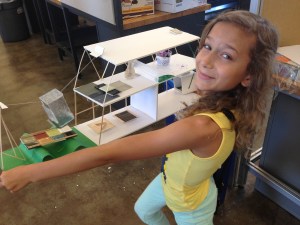
The next generation of St. Louis’ architects and designers is getting an early start on their skills. They’re building their futures, literally, through the Alberti Program, a problem-solving workshop that combines architecture, sustainable design, and creative and critical thinking.

The program is geared toward students in fourth through ninth grade in St. Louis Public Schools and surrounding districts and was started in 2007 by Bruce Lindsey, who is dean of the College and Graduate School of Architecture & Urban Design at Washington University in St. Louis’ Sam Fox School of Design & Visual Arts. In the past nine years, more than 600 children from more than 145 schools have gone through the program.

Gay Lorberbaum, a full-time senior lecturer in architecture at Sam Fox, leads the program’s curriculum.

“The idea of the program is that the kids learn about the process of problem-solving,” Lorberbaum says. “They have to come up with two- and three-dimensional solutions and learn how many factors are involved in the problem-solving process when it comes to designing spaces for people. I develop a project, and they work for an hour. It’s so exciting to see what these students can do and how quickly they’re able to integrate six or seven variables.”

The classes begin with a guest lecture. Lorberbaum brings in a wide variety of professionals to give the students a diverse understanding of the worlds of not just design, but also much more: Lecturers encompass areas of architecture, science, art, humanities, design and even “cool businesspeople,” according to Lorberbaum.

For the past five years, Tom Peterson, a principal at Mackey Mitchell Architects, has helped out as a guest lecturer with the Alberti Program. His involvement began because he and his significant other, Sue, are both architects and are in the process of renovating a 100-year-old Southwestern Bell Telephone Co. building into their home.

“It’s the perfect vehicle to teach kids lessons about architecture, design and problem-solving,” he says. “They throw out crazy ideas for what we should do with our building. As you become an adult, reality sets in. But these kids are unencumbered by reality, and the ideas just pour out of them.”

Peterson’s lessons have ranged from creating a potato gun to roof demolition. He’s taught kids about the molecular level of wood using a bundle of drinking straws and uses salvaged bits and pieces from thrift stores often, like old ski pole grips as handles for the potato guns. “Reusing discarded components not only teaches sustainability, but it also encourages creative thinking,” he says. “Sue and I have been really inspired working with this program. The kids are at the age where their creativity isn’t hindered by the reality of growing up.”

Alberti Program workshops are free for students and take place every Saturday afternoon during the fall and spring semesters on the Washington University campus. A summer session also takes place daily during the month of June. Lorberbaum and guest lecturers are aided by 25 or so Washington University graduate and undergraduate students who serve as teaching assistants, as well.

“We work hard to get kids from everywhere in the greater St. Louis area,” Lorberbaum says. “The majority of the kids are from families who couldn’t otherwise afford a program like this.”

On average, the schools are 50 percent low-income and 60 percent minority-comprised, which directly tie into Lindsey’s original mission of the program. “I started the Alberti Program for two reasons: one, because the profession of architecture is notably (not) diverse,” he says. “I got tired of hearing excuses as to why that is. The second reason is because there are almost no environmental design classes in middle and high schools. The opportunity for students to be introduced to the field is almost nonexistent. We knew introducing the field of design to young people would have positive long-term effects.”

Lindsey notes that the program started with only eight students. He says that through “the amazing connections of (Lorberbaum),” the program quickly took off, with 100-plus students per session during the school year, and 40 in the summer.

“We see this program in some ways as a recruiting effort to introduce these talented students to the field of architecture and design,” he says. “Many of these students have never set foot on a university campus, so it’s been great to have them here in the school.”

Lindsey’s goal for the future of the program is to create a more deliberate pipeline for the students. The program has been offering scholarships for the school’s Architecture Discovery Program, which runs for two weeks in the summer between junior and senior year of high school, with the hopes that these programs lead to past, present and future Alberti kids’ acceptances to schools of architecture.

“We just want to have stronger channels for our students to pursue their interests,” Lindsey says.

This story was originally published at laduenews.com. Read it on LN’s website here.

Sophia Gleissner Structural Beams SUm 2015

Ladue News Feature Stories

Well-Heeled Design – A Day in the Life of Caleres’ Angelique Joseph

It all starts with a vision of the perfect shoe. For shoe designers like Angelique Joseph, seeing footwear move from sketch to shelf is a constant process. Joseph is the lead designer for Naturalizer, a top brand for St. Louis-based international shoe company Caleres.

Many will know Caleres by its former name: Brown Shoe Co. The 137-year-old business went through a rebranding process in May and opened its new-look headquarters in Clayton just a few weeks ago. From the rebrand to the HQ alterations to Saint Louis Fashion Week, it’s been a busy year for Caleres and its employees.

But the design process never stops. Joseph says designers like her are constantly traveling both domestically and internationally, seeking out the latest trends.

“When we’re shopping, we look at all stores in the city: high end to mainstream,” Joseph says. “We look at apparel, jewelry, accessories…it all affects shoe design.”

Going to parts of the world that are currently in the season you’re designing for is key. Joseph often travels to fashion capitals such as Paris, Milan and London, along with up-and-coming places like Stockholm and Amsterdam. She also visits domestic hot spots including New York City and Los Angeles.

“We look all over to get inspired and bring our ideas back,” Joseph says. “Then we have a huge kickoff meeting where we talk about what we saw in terms of trends.”

Right now, she says, shoes with heavier soles and platforms are back in style, a style that won’t get lost in the corresponding resurgence of wide-leg pants. This is why it’s important for designers to keep an eye on apparel, accessories and jewelry in addition to footwear trends.

Joseph and her team decide what vision and look the shoes are going for, whether it’s rocker-chic, quiet attitude or something entirely different, which the company refers to as the shoe’s “story.”

“Depending on what our stories are, we start researching what’s selling and what’s working,” she says. “We see what our competitors are doing. Then, we start putting preliminary ideas down on paper.”

For Naturalizer, a brand that delivers feminine, stylish and comfortable shoes in a way that’s relevant to the busy lifestyle of today’s woman, starting from the ground up is important. Joseph says her design team starts with the bottom of the shoe and progresses up from there.

“We don’t even think about the top part of the shoe at first,” she says. “We have to figure out the overall shape of the shoe first. Does it have a blocky heel? Is it pointed? Is it square?”

Once the initial bottom shape is down, the designers can begin working on the top of the shoe, which they put together based on the stories they’ve decided on.

After getting the designs down, the designers have a series of critiques with the sales and marketing teams. They have two or three meetings before the shoe is made as a sales sample. “In the design review, they’re just seeing sketches; it’s just basic black and white on paper,” Joseph says.

The process then moves to a prototype review. The prototype is usually just one shoe in one material, just to give the teams an idea of the vision for the final product.

Joseph lists all the teams involved – and there are many – including the sales team, the sample team overseas, the fit team, the material team, the developing team, the pricing team and the production team. Although she doesn’t know exactly the number of people involved in the timeline of a Caleres shoe, she estimates it in the hundreds.

“The hardest part of the design process is selling your vision,” she says. “You have the vision and image in your head, and you can picture it. But you have to get everyone else to grasp the concept. You have to make sure you’re not too far [ahead of trends] but not too far behind, either. You don’t want to be stale.”

Joseph’s favorite parts of the job are the opportunities to travel – and, she says with a laugh, the discounted shoes. As a designer, she loves seeing people literally walking in her shoes.

She recalls being in New Orleans for her birthday and seeing a young woman on Bourbon Street wearing a pair of Naturalizer shoes that she helped design. She also saw three different pairs of shoes on three different age ranges of women, and since Naturalizer is trying to broaden its age range and diversity of products, she says that was “pretty cool.”

“It makes you feel like what you’re doing is working,” she says. “I always love going up to people and asking them why they bought the shoe. It’s so personal why you like a certain shoe and why you bought it in the first place.”

This story was originally published at laduenews.com. Read it on LN’s website here.