Ladue News Feature Stories

Love Beside a Lush Lake

Cecily Hoffius and Judith Bellos have been in business together for 37 years. In the decades they’ve run Ces & Judy’s Catering, they’ve seen the rise in the wedding industry and its plethora of opportunities. Intrigued by the possibilities, the successful duo shut down their Frontenac location to start a new venture: The Venue at Maison du Lac.

Previously, Hoffius and Bellos would visit friends of theirs who lived on a gorgeous 20-acre piece of private property in Catawissa, Missouri, less than an hour from the metro area. The property featured an 1840s stone house and sat right on a breathtaking lake.

“It feels like you are in another country,” Hoffius says.
When she and Bellos found out their friends were putting the property up for sale, they jumped at the chance to convert it into a wedding venue. They purchased the piece of land two years ago and got to work. As with any project, “It took longer than expected,” Hoffius says. They started construction in December 2017 and had their first wedding in July.

Due to its “another country” feel, The Venue at Maison du Lac has attracted engaged couples across the Midwest – especially those who want a getaway-type atmosphere without the lengthy travel.

“The thing that pushed us in this direction was all the people who seemed to be looking for what felt like a destination wedding but didn’t want to get on a plane,” Hoffius says. “We’ve created a destination that’s easily accessible from St. Louis.”

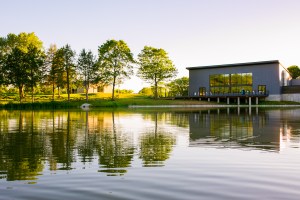
The premises feature a minimalist, modern building that the duo calls “the perfect blank canvas” for weddings of all shapes and sizes. It’s 7,000 square feet with high ceilings and large windows and features a deck overlooking the lake. The 19th-century stone house provides the perfect backdrop for photos and also serves as a luxury bridal room.

Hoffius and Bellos liked the idea of contrasting the rustic, countryside feel of the surrounding area with a modern steel-and-glass building, and architect Peter Tao was able to design something that fit the vision.

“We try to keep the building simple inside so the couples can turn it into anything they want,” Hoffius says. “The building sits right at the edge of the lake looking back at the stone house, so it’s a beautiful setting. We even purchased a small property next door to create a parking lot so we didn’t have to take out any trees.”

Since the site’s first wedding this past summer, Hoffius says she and Bellos have hosted three others, along with a post-funeral luncheon, a rehearsal dinner and a few parties. Though they haven’t hosted one yet, Hoffius says the space is also ideal for corporate retreat-type getaways. Despite the glass and steel, the sound quality inside is impeccable, and visitors have an opportunity to fish and explore the great outdoors, as well.

“It’s been exciting and a lot of work,” Hoffius says. “Judy and I are the ones taking visitors on tours, and we’ve had a lot of interest. We don’t quite have the landscaping look quite finished, but we are doing a lot of planting now and through the fall.”
When asked what sets The Venue apart from other wedding and event spaces, Hoffius doesn’t skip a beat.

“The setting is what sets us apart,” she says. “It’s just so beautiful out here. It’s relaxing.

After 37 years in the catering business, Hoffius and Bellos have seen countless events take place. They know what little things can really make a wedding day pop, and their new venue venture gives them the opportunity to bring that to their customers.

In addition to The Venue’s use as a prime spot for weddings and other events, the pair plans to host events for people in the Catawissa area.

“We’d love to do things in the coming years that are more inclusive to people in the area,” Hoffius says. “We could host movie nights and music nights for the public and give people a chance to see this beautiful spot.”

Hoffius says people ask her all the time when she’s going to retire, but it won’t be anytime soon.

“Long term, Judy and I just hope we are busy every day,” she says. “We love this business, and if we didn’t love it, we wouldn’t be in it. Seeing the looks on the faces of happy attendees – that’s what keeps us all going. It’s hard to give that up.”

This story was originally published at laduenews.com. Read it on LN’s website here.

Ladue News Feature Stories

A Revival of Grand Proportions

It all started with some motorcycles.

The year was 1999, and Steve Smith was looking for a place to keep a couple of vintage motorcycles. He had three young children at home and had run out of room in his garage, so he set out to find a small building on the fringe of downtown St. Louis where he could restore the bikes as a hobby. He happened upon a building for sale at 3323 Locust St. in the Grand Center Arts District.

“When I bought the building, I would’ve never imagined 20 years later what that would lead to,” he says.

Smith is the CEO and a founding member of architecture company Lawrence Group. He started the company with two of his fellow University of Kansas design school graduates in 1983 and has been growing his company ever since. One of Lawrence Group’s biggest clients, Saint Louis University, approached him in the early 2000s about buying the building he was storing his motorcycles in, and Smith agreed an

d moved his collection to another building nearby.

“When my motorcycle collection had become a big motorcycle collection,” Smith says, “I thought, ‘Wouldn’t it be cool to open it to the public and make it a unique ‘art of the motorcycle’ exhibition?’ That’s what led to The MOTO Museum.”

The museum opened at 3441 Olive St. in 2007 and contains almost 100 unusual bikes – mostly from Europe and around the world.

“It was a hobby on steroids,” Smith says. “[The collection] went from four motorcycles in 1999 to about 100 in 2006.”

When visitors to the museum inquired about hosting events in the space, Smith was enthusiastic about the idea but had no way to provide food for fundraisers and parties. This led to the development and opening of Triumph Grill in 2008 and the eventual opening of Hotel Ignacio next door, as well.

“Over the years, one thing has led to another – never with any real master plan,” he says. “It’s all been opportunities presenting themselves and acting on them. It’s also been realizing that both Grand Center and its great institutions are great places to be investing time and treasure to make a greater neighborhood.”

On Friday, Sept. 28, Grand Center Inc. honored Smith for his accomplishments at its annual gala, One Thousand and One Art Filled Nights. The event at The Big Top helps the Grand Center Arts District continue to establish its role as a world-class arts and business district. Smith says he’s humbled by the honor and will continue to work on making St. Louis a better place to live.

“Every community has its challenges, and we have ours, but I feel like we’re at the cusp of a new chapter in the history of St. Louis,” he says. “It’s rewarding to be a part of it.”

As the city moves into autumn 2018, there are nearly $8 billion in projects happening between the Gateway Arch grounds and Washington University in St. Louis. Grand Center and St. Louis’ midtown sit in the middle of that area geographically, making it an ideal hub for innovation and investment.

“As a region and country, we’re moving from a manufacturing economy to a knowledge economy,” Smith says. “The knowledge economy is tethered to institutions of higher education and innovation, and Grand Center is the center of St. Louis’ creative and artistic core.”

Smith and Lawrence Group currently have many projects in the works for the area, including the Saint Louis University Hospital, the first phase of construction for City Foundry STL, and the Angad Arts Hotel, opening Nov. 1.

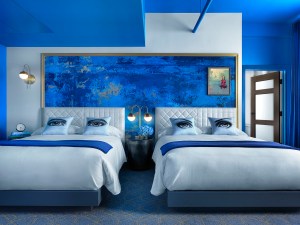
That one-of-a-kind hotel is being promoted as the first in the world where visitors can book a room by the mood they’re in. The rooms have four themes: tranquility, rejuvenation, happiness and passion. The themes are primarily manifested in color, with blue for tranquility, green for rejuvenation, yellow for happiness and red for passion. Smith is visibly excited when talking about the hotel, noting that while it may not be for everyone, everyone who visits it will have some sort of opinion on leaving.

“We’re going to have wonderful arts exhibits throughout the hotel, an incredible roof deck and a wonderful chef,” Smith says.

As for the future of Grand Center, Smith sees it progressing in growth and development as people continue to flock to the area.

“Grand Center is at an interesting point right now, because it was founded and formed to try to rebuild what was at the time a bunch of empty buildings and lots,” he says. “You drive there today, and there are no empty buildings. The next generation of Grand Center is going to be new construction and more housing for sure. Over the coming years, I see the district itself not only as a destination for the arts but also as a neighborhood where an increasing number of people live.”

In addition to introducing entirely new ideas to St. Louisans, Smith is passionate about preserving what’s been here for decades. He notes that one thing that sets St. Louis apart from cities like Nashville, Tennessee; Austin, Texas; or Charlotte, North Carolina, is its architectural heritage.

“One thing we’ve really been focusing on is taking historic treasures of St. Louis and rebirthing them,” he says. “When people come from out of town, they’re blown away by the quality of our architectural heritage. It’s a differentiator and I think it’s something St. Louis needs to more aggressively boast about.”

This story was originally published at laduenews.com. Read it on LN’s website here.
Ladue News Feature Stories

Bold As Brass

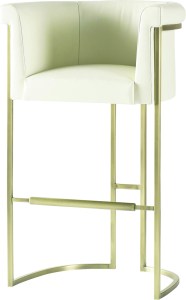
For decades, stainless steel and chrome finishes have dominated the design industry, leaving one of the formerly trendiest metals – brass – in the dust. Over the course of the past few years, however, brass has been making a slow and steady comeback, reasserting itself as a fun finish for everything from light fixtures to cabinet pulls.

Brass was a shiny staple in houses designed in the 1970s and ’80s, but the brass that’s making its way back into homes isn’t as bold as its popular predecessor 40 years ago. Instead, it’s being integrated in a matte finish, making a subdued statement on hardware and accessories across the country.

“People have tired of the stainless and brushed nickel trends,” says Kathleen Matthews, interior designer at Savvy Surrounding Style in Ladue. “The brass we are seeing today is a softer brass than before; most brass pieces are an unlacquered brass or a soft gold.”

Lauren Sweet-Schuler of Castle Design in Clayton believes brass is making a comeback because of its warm tones and how nicely it complements warm gray tones.

“I’m seeing it incorporated in many ways,” she says. “It starts in small doses and makes its way into every room.”

To reintroduce brass to your home, Sweet-Schuler recommends starting with a smaller space, like a powder room mirror or faucet hardware. Homeowners then can move on to bigger household components like a dining room chandelier. Sweet-Schuler also recommends mixing up its uses from room to room to keep it visually interesting.

“Maybe it’s hardware on a cabinet in one room and a large vase in another,” she says. “There are great ways to use it in any space.”

Matthews recommends keeping the finish subtle and staying away from the polished brass of the ’70s and ’80s to avoid a dated look. She encourages pairing today’s brass with jewel tones like a rich, dark green or a regal navy for a classic look. It can also be paired with marble in accent furniture pieces.

“The organic vibe of marble and the more industrial feel of brass can result in a dramatic cocktail table or dining room table,” she says.

Lisa Davis, visual merchandising specialist with KDR Designer Showrooms near Maryland Heights, suggests pairing brass with everything from acrylic to more natural elements.


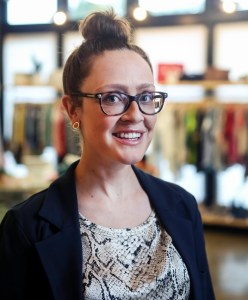
“My personal favorite is brass and acrylic, mixed together, or wood and brass for a more rustic but elegant feel,” she says.

Like Matthews and Sweet-Schuler, she’s seeing many clients starting to introduce brass into their lighting fixtures and home accessories.

“It’s an easy, inexpensive way to incorporate brass in any space, and a little goes a long way,” she says.

Although pendants and cabinet hardware reign as the most popular brass accessories right now, Matthews suggests a few unexpected ways to bring brass into your home. A modern bar cart? Yes, please.

“The finish makes the bar cart a little unexpected but also takes a functional accent piece to a new level,” she says. “A metallic brass finish is also being used in wall tiles. These tiles would make a dramatic and memorable backsplash in a residential bar area.”

Whether through subtle touches or dramatic elements, brass can be installed throughout the home as an eye-catching and striking design element. Its new matte appearance is making its way into brands across their entire line in modern, state-of-the-art pieces.

Sweet-Schuler advocates for the metal – but in a smart way.

“Brass is a finish often found in older homes,” she says, “so updating with the new matte brass finish still feels cohesive with exiting elements, while staying on-trend with the new warmer version.”

Only time will tell how long the fad continues its resurgence in the design world, but for now, designers like Matthews are enjoying its revival.

“Having been in design in the ’80s and ’90s, I was sorry to see [the brass trend] fade away,” Matthews says. “The resurgence of the unlacquered brass and gold tones is exciting! I encourage clients to add at least a few accents of brass to add an understated warmth.”

This story was originally published at laduenews.com. Read it on LN’s website here.

Ladue News Feature Stories

Hitting the Mark

Ellen Pendry had always been creative, but she never envisioned becoming a boutique owner.

Pendry had been teaching high school art for a few years before learning she was pregnant. Although a St. Louis native, she and her husband were living in Chicago, looking to return south. When he got a job and they moved back to St. Louis, Pendry was 34 weeks pregnant and knew trying to find a job at that point wouldn’t be logical with the baby’s impending arrival.

After their baby, Corinne, arrived in July 2015, Pendry found it difficult to be a stay-at-home mom with no creative outlet.

“I didn’t have a background in sewing or anything, but I just kind of went out on a limb,” Pendry says. “I wanted to make Corinne’s baptismal gown out of my wedding dress.”

She enlisted her mom (“who had made a thing or two for Halloween”) to help Pendry cut up her beloved wedding gown and was pleased with the results.

“After that, I realized how fun it was and wanted to make baby clothes to sell on Etsy,” she says.

And thus, Blue Mark Handmade was born. Pendry named the company after her very first sewing machine: a powder-blue Mark II from her grandmother. The name, to Pendry, contains the perfect amount of sentiment and professionalism.

Pendry, frustrated by the kids clothing market and its incessant sparkles and glitter, set out to craft a line that was more classic and sophisticated.

“I want my kids to wear kid versions of what I would wear,” she says. “That’s how I pick my fabrics.”

Comfort and fit were also key to Pendry’s initial efforts. As Corinne grew and after her brother, Wilson, arrived last October, the children’s mother realized the need for clothing that could be worn both to church and for play. Pendry wanted practical options – not something she’d spend too much money on only for her child to wear once. She works with knit organic fabrics in solid colors and florals, creating pieces like rompers, skirts, dresses and more.

“As far as pieces go, I will not sell anything I wouldn’t put on my own kid,” Pendry says. “These are pieces kids are comfortable being kids in.”

Some of her most popular items include twirl dresses (which Pendry says 3-year-old Corinne is obsessed with) along with peplums. All of her pieces are sold through her website and Etsy, where she has more than 200 five-star reviews.

“I’ve been humbled to hear such good things since starting Blue Mark,” Pendry says. “I hear from people that my clothing items are some of the best-quality handmade pieces they have.”

Since its inception in October 2016, Blue Mark Handmade has grown to fit each season. Right now, Pendry’s gearing up for her fall line, solely available on her website, which she’s excited to promote.

“I have the best fall colors,” she says. “I’m all about olive green, burgundy and warm, rich colors.”

She’ll be operating a bit differently this fall, though. Halfway through this summer, Pendry made the decision to switch from the made-to-order basis she was creating items from, to ready-to-ship pieces. She decided to make the switch to be able to stock up on pieces when she has time and focus on caring for her 3-year-old and 10-month-old.

Pendry moderates a VIP Facebook group for Blue Mark and has been receiving excited comments about her upcoming items. She says she’s been met with enthusiasm about the fall line’s bubble rompers with long sleeves – perfect for transitioning into autumn months.

As for the future, Pendry is looking to get her products into more stores and pursue wholesale endeavors. Blue Mark items aren’t currently available anywhere but online, but Pendry would love to be able to bring her pieces to local shops.

“It makes me feel good that I’m sending out good-quality clothes and that kids want to wear it because it’s comfy,” she says.

This story was originally published at laduenews.com. Read it on LN’s website here.

Ladue News Feature Stories

Fleur de Midtown

As a creative, Sarah-Marie Land is always seeking ways to express herself and support the things she loves. The artist, photographer and teacher is passionate about traveling, all things France – and shopping.

Land is always on the hunt for the best deals, and she eventually gathered a small collection of clothing items she wanted to turn around to a customer base. She began doing pop-ups around St. Louis under the name The Golden Fig – a name she and her sister had come up with.

“My sister and I were toying around with names and are passionate about almost all of the same things,” she says. “The golden fig just seems like this majestic, beautiful thing that you could go out and search for. I also like the symbolism of the fig: peace and prosperity.”

The pop-ups went well, and Land considered opening a small shop if she could find the right space. When she heard of a small midtown location across from Pappy’s Smokehouse on Olive Street, Land jumped at the chance.

“I really felt that I could do a lot with the space, even though it is very small,” she says. “I decided on a whim to go with it, even though I had recently found out I was pregnant.”

Land opened The Golden Fig last November and became a mom in December. Her shop is open Fridays and Saturdays (“mainly because of the baby”) and also by appointment.

Visitors to the creatively organized corner shop will first be met with an enticing aroma. Land realized the importance of a space’s scent after working a few holidays at Anthropologie in Richmond Heights and took inspiration from the well-known clothing retailer. The boutique’s walls are lined with clothing that ranges from classic colors to bright prints. Along with a curated selection of clothing items, Land also carries an array of shoes, handbags and other accessories

Drawing from her Francophile background, which includes numerous visits and a stint teaching English in Paris, Land stocks The Golden Fig with French brands that she grew to appreciate after living in France for a year and taking yearly trips there since. Visitors will find items by Jonak, Claudie Pierlot, Longchamp, Cop.Copine, Comptoir des Cotonniers and more. Along with the French influences, shop visitors will find familiar brands like J.Crew, Ralph Lauren, Kate Spade, Vera Wang and more.

“I really wanted to tie all my creative outlets into The Golden Fig,” Land says. “I go to France every summer, and there are so many brands there that I just lust over. I decided to have some unique brands you wouldn’t find elsewhere in St. Louis.”

The Golden Fig offers both new and what Land calls “pre-loved” pieces, born out of a passion for reusing and recycling clothing items instead of simply getting rid of them. She sources her inventory from all over – from department stores to online. Visitors to the shop will find new items every week.

“Resale shops are great because of the whole environmental factor of reusing and recycling what’s already out there,” she says. “I think often we dispose of things too quickly and go out and buy more. It’s important to reuse, and I don’t necessarily try to do what’s happening right this moment in the fashion world. There are pieces that are classic and always in style. I think I have a good eye with my creative background, tying into the curated sense of the shop and finding those unique pieces and how to set them up in the shop.”

In the months since the boutique’s opening, Land says she’s been getting great feedback from customers. Growth in her customer base has been increasing “slowly, but surely” as she looks to draw more visitors to St. Louis’ midtown.

“It’s been interesting with Pappy’s across the street and Chaifetz Arena nearby because I get a lot of customers from out of town,” she says. “I’m hoping more Saint Louis University students will come down. With more and more businesses coming into midtown, once it grows, people will come.”

Her goals for The Golden Fig are to increase traffic and continue to showcase brands customers perhaps haven’t seen before.

“[This store] is something I’m passionate about, and I love meeting people who come in,” she says. “Even if you think a resale shop isn’t for you, try it out. You might be surprised.”

This story was originally published at laduenews.com. Read it on LN’s website here.

Ladue News Feature Stories

Sheer Brilliance

Beyond the door of a nondescript University City brick building lies an unimaginable amount of color – a resplendence, some might say.

Sucheta Bhide rented out the massive 8,000-square-foot warehouse last fall to house her growing high-gloss lacquer and painting company, The Resplendent Crow, where she reimagines furniture in a glamorous, Hollywood Regency style.

It all started in 2013, when Bhide bought a little house in Maryland Heights and was looking for a high-gloss accent table. When she had little luck finding anything locally, she decided to research how to create the look herself. She was so pleased with the results that she did a few more pieces in her house, including a dresser.

“After a while, I realized I only had so big of a house and decided to start selling [the furniture],” she says.
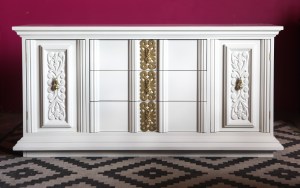
Bhide set about finding a name for her new venture, knowing she wanted a word that would describe the rich, colorful tones she was using to reimagine the pieces. Since she loves birds and used to enjoy painting them, her then-boyfriend suggested looking to feathered friends for inspiration. Bhide started researching colorful birds and stumbled across the resplendent quetzal, a Central American bird of stunning green and red.

“I knew the word ‘resplendent’ was exactly what I was looking for,” she says.

But she also wanted a not-so-serious, slightly oxymoronic feel to the name, so she tacked on the word “crow.”

“There [are] times when I feel like even though my furniture is resplendent, I’m here with my hair in a bun and covered in paint,” she says. “So I’m kind of like the crow.”

Kicking off her new venture, Bhide painted a set she had found on Craigslist and put it on Etsy. When someone from Wyoming purchased it, she realized it wasn’t just local St. Louisans who were looking for this unique glam look – it was folks from all over the country. To accommodate her growing business, Bhide knew she had to expand out of her house.

“I was doing it in my garage for a year or so, and it got so cramped,” she says. “The house would smell like paint all the time.”

Bhide started with a 1,000-square-foot warehouse on Olive Boulevard, thinking that space would be plenty.

“I outgrew it in two months,” she says. “This kind of business just needs a huge amount of storage space.”

She continued to work out of the warehouse for two years until she found her current space on Maple Avenue. The two-story building houses all the pieces that are either finished or ready for customization on the second floor, while all of the work takes place on the main level.

Although a large portion of her business consists of customers bringing in pieces to be painted, she also offers pieces that she’s sought out from all over the country. When a customer has a dresser he or she wants customized, for example, The Resplendent Crow arranges for pickup. When the piece makes it to the warehouse, Bhide and her six team members take it apart, setting the hardware aside. They sand the piece down, scuffing the surface up enough to the point where it can easily be primed. After a few coats of primer, they fix any dings and imperfections with filler. From there, the piece receives three to five coats of lacquer. Gloss finishes are what The Resplendent Crow is known for, but Bhide and her team can also do satin and matte sheens on pieces. The process takes about three to four weeks, and the finished pieces sell for an average of approximately $1,500.
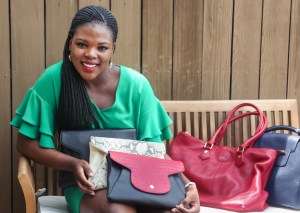
Bhide sends dressers, credenzas, chairs, desks, nightstands and more out all over the country. In a tour of her facility, she pointed out pieces that were going to California, Oklahoma, Maryland and New Jersey. One piece is even in the works to go to Hawaii.

Although she can match any color for paint, there’s one in particular that’s remained popular among her sold pieces.

“I never would’ve guessed, but I sell hot pink furniture all day long,” she says. “I think people see the colors I’ve used on social media, and they finally feel brave enough to make the jump.”

Bhide’s goal with The Resplendent Crow is to continue selling and customizing furniture, in the hopes of eventually opening a retail location. She believes it would be easier to show off the eclectic mix-and-match look people are going for in a shop-type location.

“As much as I like this space right now, it’s still a warehouse setup, and it’s hard for people to imagine the pieces in their own spaces,” she says.

Since she began her business, Bhide has been met overwhelmingly with support from her customers and suggests those interested get to know her work better by following The Resplendent Crow’s Instagram or Facebook page and also visit her Etsy shop.

“People love that they can get their old pieces of furniture customized,” she says. “They’ve come to appreciate vintage and older pieces. They’re thrilled with the transformations, especially if it’s a piece that’s theirs that they really love.”

This story was originally published at laduenews.com. Read it on LN’s website here.

Ladue News Feature Stories

Beauty Meets Function

In a world where women’s accessories are often either beautiful or functional, Ronke Faleti wanted a solution that merged the two for one of a woman’s most basic everyday items: the handbag.

The mother of three never had the desire to carry a diaper bag, but with a 6-, 3- and 1-year-old, she needed something that would work with her on-the-go lifestyle. She found a Parisian brand she was happy with, but the handbag still didn’t have all the components she needed.

Last June, Faleti put her thoughts to paper and began sketching out what she wanted to be the perfect toddler-friendly bag. She designed a statement piece first, then added in the functional aspect of the design.

“I wanted to carry a bag that I’m proud to have but one that also is able to have everything I need inside of it,” she says.

In July 2017, korédé was officially an incorporated business. The name, which means “bring goodness” in Nigerian, is at the heart of Faleti’s company. In August of last year, she was able to take sample bags out into the world and get customer feedback. She asked women what they would pay for a bag like the one she had manufactured and got their feedback on functionality.

Her first sample bag has evolved into what is now the Milola clutch. The leather handbag has three internal compartments and retails starting at $150 for a black clutch and $245 for snakeskin. Its shining feature is a dispenser opening that can be used for facial tissues or baby wipes.

“Women were gaga over that feature,” Faleti says with a laugh. “The thing about the bag a lot of women like is that it’s deceptively small. It packs a punch and has five pockets.”

The clutch also features gold-tone hardware and has a cross-body strap that’s detachable for carrying solely as a clutch. She offers the bag in black, light-toned snakeskin and a black-and-red combination.

The second bag Faleti designed was the Annabelle, a carryall relaxed leather tote that retails for $395. After doing research at retailers like Nordstrom and Saks Fifth Avenue, hearing what was selling and what wasn’t, she came up with a tote that checked all the boxes. She heard complaints about women not being able to find their belongings in a black-interior bag, so she designed hers with a light-colored interior. She heard about water bottles spilling and ruining purses, so she created a water-resistant nylon interior that can be shaken out in case of a spill, as well as an interior insulated water-bottle holder. Personally frustrated with organizer inserts for large tote bags being sold separately, Faleti incorporated hers into the Annabelle.

“The issue I saw in the organizers was that it never really fits your bag appropriately and it just eats up the space,” she says. “Ours is just built right in.”

The Annabelle has a zippered 8- by 10-inch pocket that Faleti says she often uses for keeping a change of clothes for her kids. In addition, the tote features two elastic pockets, one insulated, one mesh see-through pocket, and a key clip right at the top to keep your keys from disappearing.

“With these bags, we start with beauty – then infuse function,” she says. “I think that’s something that’s missing in the marketplace. Today’s women want function, but we love beauty.”

In the year since her launch, Faleti has worked tirelessly to pin down what the korédé persona looks like: who she is and where she’s shopping. While she’s selling her bags at shopkorede.com and at DotDotDash in Clayton for now, Faleti has big hopes and dreams for her company. She envisions a $100 million company 10 years down the road, uniting women in products that make them feel feminine, confident and attractive.

“We want to enter into the intersection of womanhood and motherhood and focus on the womanness of that person,” she says. “If our life for whatever reason adopts a new role, we don’t have to abandon those traits.”

Faleti says korédé’s ethos is “beautifully functional” and is all about products that are transitional through multiple life stages.

“From boardroom to play dates to a weekend away, korédé will take you there.”

This story was originally published at laduenews.com. Read it on LN’s website here.

Happily Ever After Stories

Happily Ever After: Nigel and the Slade Family

Once upon a time, Nancy Slade had a fondness for a particular breed of dog, leading her friends to alert her whenever there was one up for adoption in the area.

“I’ve always had a fondness for Chihuahuas, even though I’ve never had one,” Slade says. “A lot of my friends know I like them, and whenever they see one up for adoption, they post [the photos] on my Facebook wall.”

A friend of Slade’s who fosters for different rescue organizations posted a photo on her wall of a Chihuahua named Romeo from 4 Paws 4 Rescue. At the time, the Slades had a couple of other older dogs, but “this little face just stuck.”

“I showed him to my husband and said, ‘If you had a dog like this, what would you name him?’ He looked at the photo and said, ‘That looks like a Nigel to me,’” Slade says.

Nigel had a name before the Slades even contacted the rescue organization. When she called about him, his foster mom said the pup had been found in Nashville as a stray and was recovering from canine parvovirus, a highly contagious virus that can be life-threatening. She brought him to the Slade house, where the plan was to tell Slade’s children Nigel was a foster. But they all loved him from the moment they met him and knew they’d never be able to part with him.

Slade calls Nigel a “very happy guy” who loves to snuggle and burrow under blankets, where he’ll sleep all the way under the covers.
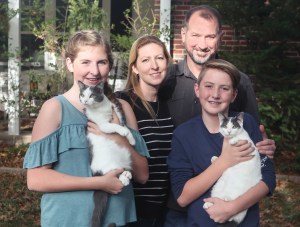
“He’s kind of like a cat,” Slade says. “He’ll sit on the sofa and look out the window.”

Though he’s a smaller dog, Slade says Nigel’s not very vocal unless there’s a squirrel.

“He hates them,” she says. “You can’t even say the word ‘squirrel’ without him freaking out.”

Despite his distaste for squirrels, Nigel is fearless – with one exception. Slade says the only time she saw him afraid was an incident where he got out of the yard. He didn’t go far, and the Slades went on foot to retrieve him since they knew where he’d be. At the top of the street, they saw him running toward them.

“There was a huge hawk flying above him chasing him,” Slade says. “He was running toward us like, ‘Save me!’”

Other than the hawk incident, the 5-year-old pup has an adventurous spirit.

“He’s been on lots of trips and loves to go boating,” she says. “He’ll stand on the chair in front so he can catch the wind and waves. He’s pretty fearless for a little guy. He rules the roost.”

This story was originally published at laduenews.com. Read it on LN’s website here.

Happily Ever After Stories

Happily Ever After: Deacon, Enid and the Stillman Family

Once upon a time, the Stillman house was full. Neighbors fondly referred to the Stillmans’ household as a petting zoo because they always seemed to house unwanted animals. Among the animals, the Stillmans had an elderly cat and were looking to adopt a second “when the time was right.”

Julianne Stillman’s 14-year-old daughter searched the internet for kittens that needed a forever home and stumbled across a picture of Enid, a kitten who was missing radial bones in her forelegs from a genetic condition. After the girl showed her mom, the Stillmans got in touch with St. Louis Pet Rescue to see about visiting the kitten.

“We met Enid and found out she has siblings,” Stillman says. “She and her brother Deacon came as a pair, and both had the genetic leg condition.”

The Stillmans fell in love with the kittens and made the decision to adopt them on the spot.

“We knew we could give them a loving home and work with their special needs,” Stillman says. “We were a bit nervous when we brought them home, though, because we weren’t sure they’d be able to do stairs.”

The Stillmans learned very quickly that since the kittens had been born with the condition, they didn’t know any different. Enid and Deacon army-crawl everywhere and sit up on their hind legs like kangaroos.

“They’re totally mobile and can jump and run like crazy,” Stillman says.

Deacon and Enid fit in perfectly with the other Stillman household animals. They’re close with the older cat, especially Enid. They also love the family guinea pig, who will chase the kittens around.

“They all run around the living room together, and the guinea pig will try to chew on [the kittens’] fur,” Stillman says. “They’re all about the same size, so it’s pretty funny to watch.”

Deacon and Enid are inseparable, but each has individual quirks. Enid is obsessed with the shower and will wait nearby until someone gets out to invade it; she’s also notorious for unrolling rolls of toilet paper.

“We’d wake up in the morning, and it will be all unrolled, shredded and everywhere,” Stillman says.

Deacon’s the more vocal of the two and will “walk around yowling.”

Although the two kitties weren’t initially part of the Stillman animal plan, Stillman says the pair came into the family’s lives when they were most needed.

“We’ve had a hard year, so I feel like they were sent to us,” she says. “They make us laugh every day.”

This story was originally published at laduenews.com. Read it on LN’s website here.

Ladue News Feature Stories

Ferguson Community Empowerment Center Builds a Beacon of Hope

In August 2014, the city of Ferguson was thrown into the global spotlight after the fatal shooting of Michael Brown by police officer Darren Wilson. In the days that followed the Aug. 9 shooting, a QuikTrip on West Florissant Avenue was looted and burned to the ground during a riot followed by an evening of otherwise peaceful protesting.

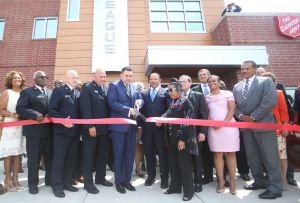
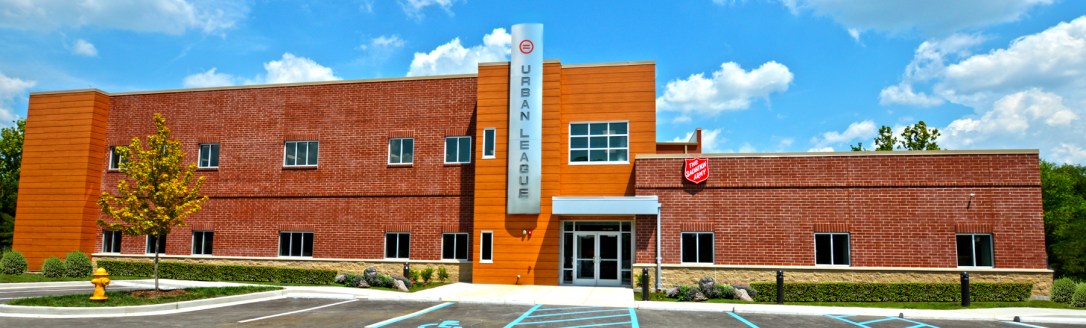
Three years later, the site of the burned-out QuikTrip is unrecognizable from what it was following then. In its place stands a state-of-the-art, multimillion-dollar facility that houses offices for the Urban League of Metropolitan St. Louis, The Salvation Army’s Midland Chapter, University of Missouri Extension and Lutheran Hope Center.

At the end of July, coinciding with the National Urban League’s annual conference taking place in St. Louis, the Ferguson Community Empowerment Center opened its doors at 9420 W. Florissant Ave. Michael McMillan, the president of the local Urban League chapter, says the center has been met with a “fantastic response” from the community in the months since its opening. Much of the interest has come from walk-in traffic, he notes, with residents of the surrounding communities curious about the resources offered at the center.

One such resource is the Save Our Sons program, which was started as a direct result of the unrest in Ferguson in 2014. McMillan, who was named president of the Urban League’s local chapter in 2013, recalls the huge outcry from young people wanting their voices to be heard.

“Usually, decision-making tables consist of people who have risen in their careers to a certain level,” he says. “As a result, a lot of times you don’t have young people in the room when decisions are being made. We made a conscious choice to get out into the community and literally walk these streets to listen to what young people needed to say.”

Though the young people of the North County community expressed a variety of opinions, one thing that was overwhelmingly stressed was the need for jobs. Urban League members looked at their statistics and found that 70 percent of their clients were female heads of households. Men, they discovered, largely weren’t taking advantage of programs.

“We wanted to tailor a program just centered around them, because African-American males in North County and north St. Louis City have three times the unemployment rate of the average citizen,” McMillan says. “We wanted to make sure we did something to rectify that and deal with it as a crisis. We created Save Our Sons, working on our federal workforce model we’ve had for the past 16 years.”
Save Our Sons is a four-week program that focuses on how to get a job, how to keep a job, how to get promoted and how to become more marketable in the workplace. It’s the Urban League’s goal to place graduates of the program in new jobs.

“We don’t consider it a success until we place you somewhere,” McMillan says. “We have hiring managers and human-resource officers come in from around the region with more than 100 partner companies we work with.”

The Urban League also takes into account the candidates’ interests, working to place them in jobs that they enjoy – something beneficial for both the employer and the employee. To date, Save Our Sons has graduated 400 men and placed them in jobs in warehousing, logistics, shipping, retail, food service, construction, information technology, and parks and conservation. As the program continues to develop and expand, McMillan hopes it can be used as a model across the region and even across the country.

“There’s significant need to expand it into the city, to East St. Louis and St. Clair County,” McMillan says. “This is an epidemic all over the country, and we’d love to have [the program model] utilized everywhere. In the Urban League movement with almost 100 [chapters] across the country, we’re constantly trying to show best practices and learn from each other.”

The Ferguson Community Empowerment Center is truly a collaborative effort. Construction for the $5.8 million building was paid in full, with funding from donors, St. Louis County tax credits, co-owner The Salvation Army and TIAA Direct. University of Missouri-St. Louis’ extension program operates a satellite office out of the building, and Lutheran Hope Center also has offices there. Other organizations, like Better Family Life and Provident, will be able to use the building for events.

“We’re most proud of the fact that there’s been so much overwhelming support from everyone we asked to be a part of this in any way whatsoever,” McMillan says. “Every part of society here has been so supportive, and we couldn’t be happier.”

As for the center’s future, McMillan hopes tens of thousands of people will be able to come through its doors to get services and build better lives for themselves and the community around them.

“We want to constantly promote the spirit of giving back,” he says. “No matter a person’s circumstance, we hope they would use the gifts they’ve been given to give of their time to help others and that this building would be a beacon of that – of helping others and making a difference in the community.”

This story was originally published at laduenews.com. Read it on LN’s website here.