Happily Ever After Stories

Happily Ever After: Maloney and the Andrew Family

Once upon a time, a 7-year-old terrier mix was found shivering in an abandoned garage in North City, sleeping on a bag of trash. Winter of 2014 was a cold one, and Stray Rescue of St. Louis volunteers were doing their best to get as many strays off the streets as possible. They were desperate for foster families, and Valerie Andrew answered the call for the terrier mix, named Maloney.

Andrew had fostered for Stray Rescue many years prior and had adopted her older dog, Friede, from them. Stray Rescue told her she could come down to the shelter the next day and to bring Friede to the meet-and-greet room so they could all get acquainted.

“The first thing I thought was ‘He’s so big!’” Andrew says. “He was about 60 pounds then, and he’s 70 now.”

The dogs got along just fine, and Andrew agreed to take Maloney home as a foster. He was extremely skittish. Andrew says although she doesn’t know much about his life before ending up at Stray Rescue, she’s pretty sure he had been abused in some way.

“He was afraid of everything,” she says. “He ran away down the street the first day, but the Stray Rescue folks helped get him back home.”

The first days were rough for Maloney and his new mom. Andrew worried he would never bond with her. She turned to the folks at Stray Rescue for help, and they recommended putting peanut butter on her finger.

“That did the trick,” she recalls.

While fostering Maloney, Andrew took him to a few adoption events, which is a customary practice for dogs in foster care.

“I was so afraid someone was going to be interested in him,” she says. “That’s when I knew I had to keep him.”

Maloney got to be one of the Stray Rescue All Stars at this past December’s Hope for the Holidays Gala at The Chase Park Plaza and is featured on the organization’s calendar as Mr. March.

“People are really attracted to him because of his speckled nose,” Andrew says. “Then, once they get to know him, they realize what a sweetheart he is.”

Andrew and her four-legged crew belong to the Woodson Road Dog Park in Overland, and Maloney loves getting to meet new friends there.

“He loves to chase with the other dogs, but his favorite thing is just to get a squeaky toy and parade around with it,” Andrew says.

Maloney has been a bit of a menace to Andrew’s garden. It turns out, he loves broccoli and kale, and will eat both right off the plant.

“He also loves orange slices, but only if you eat half of it and give him the other half,” she says.

Andrew describes her life as “richer” now that Maloney is in it. She has other animals that she adores, but something told her it was time to do something more and foster.

“Every day is something new and exciting,” she says. “Who rescued who?”

This story was originally published at laduenews.com. Read it on LN’s website here.

56fc5280ec403.image

Happily Ever After Stories

Happily Ever After: Baxter and the Mayuga Family

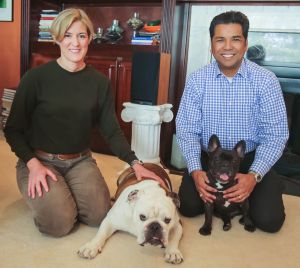
Once upon a time, Ed and Ann Marie Mayuga fell in love with an English bulldog named Mr. President. They had him from a puppy, and he was a “character,” Ed Mayuga says. Mr. President became a fixture in the St. Louis English bulldog meet-up groups, and everyone loved him. The Mayugas wanted Mr. President to have a friend, so they adopted a French bulldog named Popcorn.

“They were like peas in a pod,” Mayuga says.

Unfortunately, Popcorn got cancer when he was around 8 years old. The Mayugas did a lot to try to save him, but the cancer took over, and they had to put him down in September 2013.

Mr. President was lonely. He had lost his best friend.

“We knew he needed a companion,” Mayuga says. “I was on Facebook and saw that Baxter needed a foster family.”

St. Louis English Bulldog Rescue president Diana Engeszer brought Baxter over, and he and Mr. President played all afternoon. Mr. President, a senior dog by English bulldog standards, got overheated and was uncomfortable all night. The Mayugas found out the next morning that he had passed away overnight.

“We had lost two amazing dogs in 10 days,” Mayuga says.

It was a tough time for the Mayugas, but they decided to adopt Baxter. He helped them through the loss of Mr. President and Popcorn, and they even ended up adopting another bulldog: a French one named Bonaparte.

“We owe a lot to St. Louis English Bulldog Rescue,” Mayuga says. “We don’t have any children, so our dogs are our children. A lot of times, people don’t want to adopt bulldogs because they only live about 8 or 9 years and often have health problems. But we’re so grateful for ours.”

Baxter and Bonaparte are healthy and spoiled. They wear matching outfits and get to go shopping with the Mayugas. Since the couple works out of their home, the bulldogs get a lot of attention. Baxter can be a bit mischievous at times, Mayuga says.

“We have a guest bedroom with a low bed, and if the door is left open even a crack, we’ll find Baxter in there, buried under the pillows,” Mayuga says. “He makes a nest and buries himself.”

The Mayugas speak highly of bulldogs as a breed, and Ed Mayuga says they’re like “little clowns.”

“People who don’t know bulldogs often think they’re fierce,” he says. “Nothing is further from the truth. They’re sweet little lap dogs.”

Baxter certainly has his quirks. Mayuga’s parents, who are retired and live down the street, watch the dogs from time to time. Occasionally, Baxter will get to whining, and Mayuga’s parents know just what to do.

“He wants a car ride,” he says. “They’ll put him in the car and drive him in a 10-mile loop. He loves it.”

Baxter absolutely loves Ann Marie Mayuga and will follow her all over the house, her spouse says.

“If you don’t shut the bathroom door when you shower, he’ll be asleep and snoring on the bathmat when you get out,” he says.

When all is said and done, Baxter and Bonaparte make the perfect companions to the Mayugas.

“No matter how my day goes, they’re always there and so happy to see me,” Mayuga says. “Ican’t imagine life without them.”

This story was originally published at laduenews.com. Read it on LN’s website here.

56d8b4d855b4d.image

Happily Ever After Stories

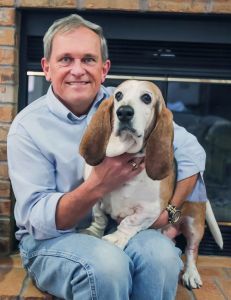
Happily Ever After: Rudy and the Hunt Family

Once upon a time, Rudy the basset hound was accidentally hit by a vehicle. The six-year-old pup had been living in Kirksville when the collision caused a very bad break in one of his back legs.

Guardian Angel Basset Rescue, which is based out of Dwight, Illinois, but helps bassets as far south as St. Louis, got a call from an animal shelter in Kirksville about poor Rudy. The call said the break was practically inoperable, and Rudy would have to be put down.

Enter Don Hunt, a Guardian Angel volunteer. He told the animal shelter he would help Rudy, and after they transported Rudy south, Hunt took him to Creve Coeur Animal Hospital. Wanting to get a second opinion, Hunt did some research and found someone who could help Rudy avoid amputation.

Hunt and Rudy made the nearly four-hour, 250-mile journey north to Pine Bluff Animal Hospital in Morris, Illinois, where Dr. Brian Schmidt said he could help Rudy.

A plate, six screws and a wire later, “you would never know Rudy’s leg was broken,” Hunt says. Rudy’s bills have been about $5,000 so far, and that’s including the discounts Guardian Angel has received.

But that hasn’t deterred Hunt’s love for his short-legged friend. Hunt, Rudy and a few other bassets reside in Belleville, and Hunt helps out with Guardian Angel whenever he can.

“I’ve been involved [with Guardian Angel] for about four years,” he says. “I got my first basset 25 years ago.”

About four years ago, the death of one of Hunt’s bassets hit him really hard. Seeking solace, he found Guardian Angel, and members of the group brought over a dog. From there, he got involved with transporting and fostering the breed for the rescue organization.

“I’ve driven probably 55,000 miles and visited 10 states transporting dogs and taking them to their forever homes,” he says. “The longest trip was 865 miles in one day. If a basset needs help, within reason, we’ll do it.”

Citing some information from Guardian Angel, he says the organization has been able to save 4,200 bassets over the past 17 years.

As for his own pack, Hunt says they all get along very well. This could be because they’re on the older end of the age spectrum.

“I’m a sucker for senior dogs,” he says. “Rudy is the youngest of mine, at seven years old.”

Hunt says senior dogs are great because they’re very set in their ways. There are rarely fights, he says, but they occasionally get into scuffles over food.

Rudy is especially “precious” to Hunt, he says. “He’s a total love bug.”

Every year, Guardian Angel hosts a “Waddle” event for basset mixes and their owners, and Rudy was named king.

“He’s been through so much,” Hunt says. “One of these days, the plate [in his leg] will need to come out, but the doctor saw him in September and said the X-rays looked fine.”

For now, Rudy and his forever family are content to lounge around Hunt’s home, relaxing on both dog and human beds.

“He likes to sleep next to me,” Hunt says. “When I’m walking around and have sweatpants on, he’ll tug on them. He’s the cutest.”

This story was originally published at laduenews.com. Read it on LN’s website here.

56b3bf9a52ed6.image

Ladue News Feature Stories

Architects of Tomorrow – The Alberti Program

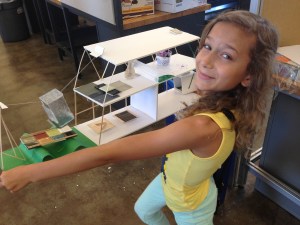
The next generation of St. Louis’ architects and designers is getting an early start on their skills. They’re building their futures, literally, through the Alberti Program, a problem-solving workshop that combines architecture, sustainable design, and creative and critical thinking.

The program is geared toward students in fourth through ninth grade in St. Louis Public Schools and surrounding districts and was started in 2007 by Bruce Lindsey, who is dean of the College and Graduate School of Architecture & Urban Design at Washington University in St. Louis’ Sam Fox School of Design & Visual Arts. In the past nine years, more than 600 children from more than 145 schools have gone through the program.

Gay Lorberbaum, a full-time senior lecturer in architecture at Sam Fox, leads the program’s curriculum.

“The idea of the program is that the kids learn about the process of problem-solving,” Lorberbaum says. “They have to come up with two- and three-dimensional solutions and learn how many factors are involved in the problem-solving process when it comes to designing spaces for people. I develop a project, and they work for an hour. It’s so exciting to see what these students can do and how quickly they’re able to integrate six or seven variables.”

The classes begin with a guest lecture. Lorberbaum brings in a wide variety of professionals to give the students a diverse understanding of the worlds of not just design, but also much more: Lecturers encompass areas of architecture, science, art, humanities, design and even “cool businesspeople,” according to Lorberbaum.

For the past five years, Tom Peterson, a principal at Mackey Mitchell Architects, has helped out as a guest lecturer with the Alberti Program. His involvement began because he and his significant other, Sue, are both architects and are in the process of renovating a 100-year-old Southwestern Bell Telephone Co. building into their home.

“It’s the perfect vehicle to teach kids lessons about architecture, design and problem-solving,” he says. “They throw out crazy ideas for what we should do with our building. As you become an adult, reality sets in. But these kids are unencumbered by reality, and the ideas just pour out of them.”

Peterson’s lessons have ranged from creating a potato gun to roof demolition. He’s taught kids about the molecular level of wood using a bundle of drinking straws and uses salvaged bits and pieces from thrift stores often, like old ski pole grips as handles for the potato guns. “Reusing discarded components not only teaches sustainability, but it also encourages creative thinking,” he says. “Sue and I have been really inspired working with this program. The kids are at the age where their creativity isn’t hindered by the reality of growing up.”

Alberti Program workshops are free for students and take place every Saturday afternoon during the fall and spring semesters on the Washington University campus. A summer session also takes place daily during the month of June. Lorberbaum and guest lecturers are aided by 25 or so Washington University graduate and undergraduate students who serve as teaching assistants, as well.

“We work hard to get kids from everywhere in the greater St. Louis area,” Lorberbaum says. “The majority of the kids are from families who couldn’t otherwise afford a program like this.”

On average, the schools are 50 percent low-income and 60 percent minority-comprised, which directly tie into Lindsey’s original mission of the program. “I started the Alberti Program for two reasons: one, because the profession of architecture is notably (not) diverse,” he says. “I got tired of hearing excuses as to why that is. The second reason is because there are almost no environmental design classes in middle and high schools. The opportunity for students to be introduced to the field is almost nonexistent. We knew introducing the field of design to young people would have positive long-term effects.”

Lindsey notes that the program started with only eight students. He says that through “the amazing connections of (Lorberbaum),” the program quickly took off, with 100-plus students per session during the school year, and 40 in the summer.

“We see this program in some ways as a recruiting effort to introduce these talented students to the field of architecture and design,” he says. “Many of these students have never set foot on a university campus, so it’s been great to have them here in the school.”

Lindsey’s goal for the future of the program is to create a more deliberate pipeline for the students. The program has been offering scholarships for the school’s Architecture Discovery Program, which runs for two weeks in the summer between junior and senior year of high school, with the hopes that these programs lead to past, present and future Alberti kids’ acceptances to schools of architecture.

“We just want to have stronger channels for our students to pursue their interests,” Lindsey says.

This story was originally published at laduenews.com. Read it on LN’s website here.

Sophia Gleissner Structural Beams SUm 2015

Happily Ever After Stories

Happily Ever After: Billy, Bob and the Krusie Family

Once upon a time, Claire Krusie went into PetSmart for a gecko and came out with a dog. About 12 years ago, Krusie left the store with Billy, a tiny 8-pound puppy that she “just couldn’t leave without.”

She was able to adopt Billy through PetSmart because Open Door Animal Sanctuary sometimes hosts adoption events through the chain pet store.

Krusie was instantly protective of Billy because of his size. “People still think he’s a puppy because of his size,” Krusie says of now 12-year-old Billy.

Krusie is a preschool teacher and works long hours. She’s gone a lot and hates leaving Billy alone. He wasn’t the spunky puppy he once was and has heart murmurs.

One day, Krusie went back into PetSmart for dog food and ended up leaving with a new addition: a 7-month-old cat, also from Open Door.

“I was pretty worried about bringing another animal into the house,” she says. “Billy has neurological damage, and I’m very cautious.”

When the cat met Billy, the first thing he did was crawl in the kennel with the dog.

“They just laid down together and have been best friends ever since,” Krusie says.

The cat, originally named Jeff, became Bob because Krusie thought the two names went together nicely.

Krusie says they look like brothers because of their similar markings. Billy, who Krusie thinks might have some Jack Russell and corgi in him, is mostly white with some brown. His brother Bob is the same.

“Billy and Bob play together all day,” Krusie says. “Bob has really brought out this life in Billy that he had kind of lost in his old age.”

The two have been inseparable since Krusie brought Bob home about two months ago.

She says Bob is truly “the king of the castle” and won’t let Billy do anything without him.

“When they eat breakfast, I have to separate them because they’ll sit right next to each other,” she says. “At night, Billy sleeps in our bed, and Bob usually sort of does his own thing. But when they sleep at the same time, they have to be touching.”

During the days, Bob – being the considerably younger of the pair – constantly wants to play. “He’ll take his cat toys and bring them to the dog, asking him to come and play” Krusie says. “Billy is still figuring that out.”

Though the four-legged elder is still confused at times by his younger playmate, they’ll spend hours running around and chasing each other.

When they finally exhaust their energy, they have to sleep in the same place. Krusie says she tried buying separate beds for them, but the pair won’t use them.

She calls them a “quirky” duo, but they’re very protective of each other.

Billy not only has neurological damage, but arthritis and cataracts as well. He’s had a lot of the problems from a young age, but more have emerged as he’s aged, Krusie says.

“A lot of the issues he was having have stabilized since we brought Bob home,” she says. “Having a pet for your pet can help keep them healthy. We’re so blessed to have them both.”

Krusie says the long-running stereotypes about dogs and cats not getting along don’t apply to these two at all.

“It was my biggest fear (bringing Bob home), but it’s really nature versus nurture,” she says. “The reason I went with a cat is because Billy is so small. He has no idea what he is – he probably thinks he’s a cat!”

It’s been love at first site for the dog-cat pair, though. Although they’re still trying to figure each other out, Krusie says the two species aren’t very different.

“If animals are given love, they’re going to give love in return,” she says. “We’re thrilled Bob can break those stereotypes.”

Krusie can’t say enough about Open Door Animal Sanctuary and is so happy the House Springs shelter brought the dog, cat and human family together.

“Open Door saved my dog by bringing him to me, but also bringing Bob to him,” Krusie says. “Those are awesome instances where they’ve helped bring two amazing animals into our life.”

This story was originally published at laduenews.com. Read it on LN’s website here.

568e96a9c1c99.image

Uncategorized

Top 50 Tracks of 2015

11537901_10204743231323169_1598819578606689026_o

Last year, I made a list of my favorite music moments of 2014: the EPs, the full-length albums, the songs. (You can find that here). This year, I started keeping track of my favorite songs of 2015 on the very first day of January. I refined it a bit as the year went on, but this is the final product.

My music tastes have shifted and morphed quite a bit in the past year, but my passion for electronic music in a variety of forms remains strong. In 2015, many of my favorite artists have branched out and tried new things. It’s been fun to see their growth as artists and see their fans (myself included) embrace music they otherwise wouldn’t have sought out.

Some of my favorite artists to watch this year have been Illenium, Didrick, Laetho, Said The Sky, Grabbitz, Lost Kings, marshmello, Fareoh, Pusher, Heavy Mellow, ATTLAS, Halogen, Summer Was Fun, Gryffin, Lenno, StéLouse, Young Bombs and Stephen. These guys have consistently put out absolute gold, and I look forward to each new release. 2016 is full of promise for them, and I can’t wait to see what they do next.

I spent my concerts of 2015 with a pretty wide variety of people – as varied as my concert choices were (everything from A Skylit Drive to String Cheese Incident to Arty to Sublime with Rome). Shout-out to all of you for making the concerts even better. You know who you are.

2016 looks bright. While many people only see the bad in electronic music and the industry that surrounds it, there’s so much passion and innovation if you know where to look. Stay humble. Spread good vibes. Here’s to a great 2015 and an even greater 2016!

11709615_10154001940747785_4136584500729527307_n

Ladue News Feature Stories

Well-Heeled Design – A Day in the Life of Caleres’ Angelique Joseph

It all starts with a vision of the perfect shoe. For shoe designers like Angelique Joseph, seeing footwear move from sketch to shelf is a constant process. Joseph is the lead designer for Naturalizer, a top brand for St. Louis-based international shoe company Caleres.

Many will know Caleres by its former name: Brown Shoe Co. The 137-year-old business went through a rebranding process in May and opened its new-look headquarters in Clayton just a few weeks ago. From the rebrand to the HQ alterations to Saint Louis Fashion Week, it’s been a busy year for Caleres and its employees.

But the design process never stops. Joseph says designers like her are constantly traveling both domestically and internationally, seeking out the latest trends.

“When we’re shopping, we look at all stores in the city: high end to mainstream,” Joseph says. “We look at apparel, jewelry, accessories…it all affects shoe design.”

Going to parts of the world that are currently in the season you’re designing for is key. Joseph often travels to fashion capitals such as Paris, Milan and London, along with up-and-coming places like Stockholm and Amsterdam. She also visits domestic hot spots including New York City and Los Angeles.

“We look all over to get inspired and bring our ideas back,” Joseph says. “Then we have a huge kickoff meeting where we talk about what we saw in terms of trends.”

Right now, she says, shoes with heavier soles and platforms are back in style, a style that won’t get lost in the corresponding resurgence of wide-leg pants. This is why it’s important for designers to keep an eye on apparel, accessories and jewelry in addition to footwear trends.

Joseph and her team decide what vision and look the shoes are going for, whether it’s rocker-chic, quiet attitude or something entirely different, which the company refers to as the shoe’s “story.”

“Depending on what our stories are, we start researching what’s selling and what’s working,” she says. “We see what our competitors are doing. Then, we start putting preliminary ideas down on paper.”

For Naturalizer, a brand that delivers feminine, stylish and comfortable shoes in a way that’s relevant to the busy lifestyle of today’s woman, starting from the ground up is important. Joseph says her design team starts with the bottom of the shoe and progresses up from there.

“We don’t even think about the top part of the shoe at first,” she says. “We have to figure out the overall shape of the shoe first. Does it have a blocky heel? Is it pointed? Is it square?”

Once the initial bottom shape is down, the designers can begin working on the top of the shoe, which they put together based on the stories they’ve decided on.

After getting the designs down, the designers have a series of critiques with the sales and marketing teams. They have two or three meetings before the shoe is made as a sales sample. “In the design review, they’re just seeing sketches; it’s just basic black and white on paper,” Joseph says.

The process then moves to a prototype review. The prototype is usually just one shoe in one material, just to give the teams an idea of the vision for the final product.

Joseph lists all the teams involved – and there are many – including the sales team, the sample team overseas, the fit team, the material team, the developing team, the pricing team and the production team. Although she doesn’t know exactly the number of people involved in the timeline of a Caleres shoe, she estimates it in the hundreds.

“The hardest part of the design process is selling your vision,” she says. “You have the vision and image in your head, and you can picture it. But you have to get everyone else to grasp the concept. You have to make sure you’re not too far [ahead of trends] but not too far behind, either. You don’t want to be stale.”

Joseph’s favorite parts of the job are the opportunities to travel – and, she says with a laugh, the discounted shoes. As a designer, she loves seeing people literally walking in her shoes.

She recalls being in New Orleans for her birthday and seeing a young woman on Bourbon Street wearing a pair of Naturalizer shoes that she helped design. She also saw three different pairs of shoes on three different age ranges of women, and since Naturalizer is trying to broaden its age range and diversity of products, she says that was “pretty cool.”

“It makes you feel like what you’re doing is working,” she says. “I always love going up to people and asking them why they bought the shoe. It’s so personal why you like a certain shoe and why you bought it in the first place.”

This story was originally published at laduenews.com. Read it on LN’s website here.


Ladue News Feature Stories

Hunting House History

St. Louisans pass by historic homes every day in St. Louis city and county, though they are rarely given a second glance. Yet these houses are full of rich history and colorful stories, many of them due to their former homeowners, buried underneath layers of wallpaper and tile. You might even live in a St. Louis house that’s more than 100 years old, but how much do you know about the time period when it was built, the people who lived in it or what purposes rooms previously served?

For Missouri History Museum associate archivist Dennis Northcott, helping people research their historic homes is more than just a hobby – it’s his job. It’s also something he’s overwhelmingly passionate about, which is evident when curious home researchers stop by the Missouri History Museum Library and Research Center on South Skinker Boulevard. Under its towering dome, St. Louisans can peruse hundreds of old publications, censuses, deeds, genealogy indexes, city directories, property plans, real estate ads and more to find out how their homes came to look the way they do now.

About 10 years ago, Northcott began taking bits of information that were indexed in the research center and inputting them into Microsoft Access. With a little IT help, Northcott was able to create an interface on the history museum’s website that, at first, was used to help genealogists search people by name.

“It’s an ongoing index of all this data we have in our collections,” Northcott says. “This includes neighborhood newsletters, employee magazines, scrapbooks, yearbooks…all kinds of stuff.”

He soon realized people wanted to search for their properties as well as names. Northcott created a house history research guide page on the museum library’s website, which is where he directs people initially.

From there, Northcott’s methods to help people find what they’re looking for vary by what information they have about their home. Oftentimes, the best place to start when arriving at the research center is to consult a city directory, a volume structured similarly to phone books and published annually. St. Louis City directories go back to 1821; St. Louis County directories go back to 1893.

“You can look up someone’s name, and it tells you what their occupation was and where they were living,” Northcott says. “Around 1930 or so, they started including a feature in the back where you could look up your community.”

After finding a community – for example, Clayton’s DeMun neighborhood – you can look up addresses in the neighborhood, house by house, to find out who lived there. Then, you can look up the name and possibly find out the residents’ occupation and other household members year by year.

After discovering names, the research center’s genealogy index can help with the next step: finding obituaries, photos and other scraps from the homeowners’ lives.

Northcott also notes the importance of maps in researching a house’s history and points to resources like fire-insurance maps. “Fire-insurance companies wanted to know how much to charge for fire insurance for commercial buildings and homes, so they published these maps showing the entire city,” he says. “They’re color-coded by building material: Pink means brick, yellow is frame and blue is stone. Sometimes people will use these and find out there used to be a frame porch or a garage out back that they saw the foundation for.”

Erin Sutherland, for example, was convinced the railing across the front of her Richmond Heights home wasn’t supposed to be there.

“As an art historian, it bothered me because it’s not right architecturally,” she says. “But before I went about changing anything, I had to make sure I was historically correct.”

Not wanting to compromise the historical integrity of her home, Sutherland used the research center’s resources to see what she could find. After entering her address on the website, she discovered a photo of her home from a 1931 Union Electric employee magazine showing the front of her house, and sure enough, she was correct – no railing. Now, she’s working to change it back to the way it was. She also found out a marshal was stabbed on the street in her neighborhood in 1922 because of bandits in the area at the time. Northcott isn’t surprised by what Sutherland discovered: “Researching your home can lead all over the place. It’s absolutely fascinating.”

Northcott and the research center staff are constantly indexing new vintage materials to help researchers find information about the past. Books including “Historical Home Research in the City of St. Louis” by Edna Campos Gravenhorst and “Who’s Been Sleeping in My Bed(room): Researching a St. Louis County, Missouri Home” by Kim Wolterman are available at the research center, as well. Recently, historic St. Louis newspapers have been digitized and rendered keyword-searchable; the St. Louis Post-Dispatch, for example, can be searched from 1874 to 1922.

Northcott says he has a “crazy obsession” with trying to identify every building image the research center has on file. He teaches a house history workshop twice a year and says attendees almost always want a historic photo of their home first and foremost.

“Our archives have thousands and thousands of historic St. Louis homes, but unfortunately, we don’t have photos of everything,” he says.

Emily Jaycox, the head librarian at the research center, has researched two of her St. Louis homes. Her former home, she says, had nice woodwork that had never been painted – she found out the first owner was a varnish salesman.

“The house I live in now was built in 1919 and has more closets than any place I’ve ever lived, which wasn’t common for a house of that era,” Jaycox says. “I did some research and found out the man who built the house was in the family business of custom tailoring. They made suits for the mayor, and it turned out to be a three-generation business. So that explains the closets.”

Although she never found a picture of her home, she gained a better understanding and appreciation for its eclectic history.

Northcott agrees. “I always say that if you interviewed a thousand people walking down the street and asked them if they wanted to do research at a library today, nobody would say yes,” he says. “But if you asked people if they want to see a picture of their house from 1930 or a document signed by their great-great-grandfather, every single person would think it was great.”

This story was originally published at laduenews.com. Read it on LN’s website here.

Ladue News Feature Stories

Q & A with John Irving

Novelist and screenwriter John Irving has published more than a dozen books – he is perhaps best known for his first novel, “The World According to Garp,” and a later novel (whose screenplay garnered him an Academy Award), “The Cider House Rules.” Irving will be in St. Louis at the St. Louis Speakers Series, presented by Maryville University, on Tue., Oct. 13. LN caught up with him in advance of his visit.

You’ve said many times before that you write your last sentence of your books first. Has it always been that way, since your first book in 1968?

It has always been that way, and I don’t imagine my process will change. It seems to work and seems to be the way I need to begin every story. I don’t feel confident to begin a novel until I know everything that will happen in it, most especially how it ends. Oftentimes, it’s more than the last sentence. Sometimes, it’s the last few paragraphs. It isn’t a religion for me, though. If in the process of writing a novel, I saw midway through there was a better last sentence, I wouldn’t hesitate to change it, and I hope I have the sense to recognize it. My novels are developed over years, not over a weekend.

Process-wise, how does working on a screenplay for a book like The Cider House Rules differ from working on a novel?

In the first place, I don’t usually see or imagine my novels as films. In many cases and most cases, even when asked, I’m not inclined to be part of an adaptation process if I don’t see myself that the film might be contained in that novel. However, I like writing screenplays. I’ve written original screenplays, and in the course of revising them and reworking them, they kind of naturally evolve into something bigger than a movie. I find writing screenplays a good way to find out if you want to write a novel. It’s a lot easier to develop a screenplay to a novel than to throw so much of it away. For example, the novel of “The Cider House Rules” takes place over 50 years. The film takes place over 18 months. The hardest part of that adaptation was losing those years, because that has a serious influence on what happens in the story and characters connected to the novel.

Lately, I like the (screenplay-writing) process if I’m thinking about an idea and wondering if it might be better as film. I’ll write it as a film because it’s easier.

I’m grateful for the experience I’ve had writing screenplays. I wrote an adaptation of my first novel, which was never made into a movie. I didn’t feel good about it at the time. It wasn’t a happy experience and I didn’t feel like repeating it right away. But the experience wasn’t wasted, because I learned how to do something.

Do you have a philosophy on life? If so, what character of yours best embodies it?

No, I don’t. I’m a fiction writer – I make things up. Real life doesn’t overwhelm me or impress me very much. To put it in perspective, when I see a film or book that’s advertised as “based on a true story,” I realize the story could be better if the writer with more imagination could’ve made it up. “Based on a true story” can only be as good as what happened.

Can you tell us a little bit about “Avenue of Mysteries,” out Nov. 3? Where did the idea for the book come from? What do you want people to take away from it?

“Avenue of Mysteries” is about a Mexican-American who lives the first 14 years of life in southern Mexico, then leaves at 14 and never goes back. The experience and what happens to him in his childhood is the most formative time in his life and we later follow him as an older man as a trip to the Philippines, 40 years after his time in Mexico. Nothing has ever been quite the same for him after his childhood. That trip triggers dreams of childhood. There are parallels, and the older man’s memory of what haunts him in the past is triggered by the trip. Simply put, it’s about a Mexican-American who takes a trip to the Philippines. [Irving laughs.] It’s about a guy whose experience up to age 14 is never matched.

The ideas for stories and characters in my books don’t really come from a single moment, so much as they emerge over time from thinking of a character in a certain situation and what life-changing or life-lasting effects the situations we encounter as children or adolescence can have on a person. That’s a fair description of all my novels. They’re founded on the premise that what happens to us or what can happen to us in those formative years cannot only make us who we become as adults, but in some instances, as we grow older, dominate even our older lives. The older we get, the more we live in our memories and in our dreams from the past. I’ve always put a considerable belief in the past, or in the foundations of the past and its effect on what becomes of us in our later and grown-up lives.

This story was originally published at laduenews.com. Read it on LN’s website here.

John Irving headshot

Ladue News Feature Stories

Sharing St. Louis’ Magic: Regional Arts Commission’s Felicia Shaw

St. Louis native Felicia Shaw called California home for almost four decades. While she considered it a great place to live, it wasn’t her hometown. Earlier this year, an opportunity arose that brought her back to her beloved St. Louis. As the Regional Arts Commission’s (RAC) new executive director, Shaw’s aim is to impact the local arts scene by propelling St. Louis to the next level.

Shaw’s background is in the arts, specifically arts administration. She worked for 12 years as a program manager for the City of San Diego Commission for Arts and Culture, and for the past seven years as the director of the arts program at the San Diego Foundation. That position was eliminated last year, and she found herself looking for a new direction, which brought her back to St. Louis.

Shaw says last year’s events in Ferguson further influenced her decision to move home. “I want to make a new imprint in the hearts and minds of people so we highlight what’s really working (in St. Louis) and what’s good here,” she says. “We can use arts as a tool to make St. Louis a safer and more vibrant place to live.”

Shaw has high praise for the local arts and culture community, and since assuming RAC’s executive director position in May, she’s been working to further expand St. Louis’ reputation as an artistically creative region. “As a city, we’re highly ranked for sports,” she says. “But when I think about the vibrancy of our arts culture, St. Louis should be ranked much higher in that area, too.”

St. Louis is an arts town, Shaw says, with a deeply ingrained and mature community of artists and art enthusiasts. “One of the things I missed the most when I was in San Diego was The Muny,” she says. “We tried to have a similar concept in San Diego, but it didn’t work out. St. Louis is special. The Muny provides magical nights under the stars all summer long.”

Shaw is proud to be leading RAC and looks forward to moving the organization and all of its branches forward. “The legacy of RAC is so strong,” she says. “This isn’t a turnaround situation, because (RAC) is already doing such a great job. I’m not here to fix anything – I’m here to take it to the next level.”

One of the first orders of business for Shaw as executive director was to dedicate time to go out and listen to citizens in the community. She and her team devised a series of dialogues in which they invited a handful of people to come and tell them about the trends and issues impacting the region. “We fund 250 organizations,” she says. “Obviously, we can’t sit down with all of them individually to hear their comments and concerns, but this was a good way to hear what’s going on.”

For Shaw, the current St. Louis art scene is exciting. “Artists themselves are evolving,” she explains. “They’re looking at their work as a small business.” This is good for St. Louis as it moves out of the recession and focuses on the entrepreneurial economy, she says, noting that here, artists can live more affordably, do cutting-edge work and position themselves as micro-enterprises.

“Artistic practice is changing,” Shaw says. “Artists aren’t going the traditional route. They’re busting out of their framework all together and taking their art to the streets.” She notes how the Ferguson unrest has changed art in St. Louis for the better. “Artists’ responses to Ferguson really helped people connect with their feelings,” she says. “They’re working in the traditional sense, but also working with social justice.”

Luckily, the people of St. Louis “really accept the arts as a part of their daily lives.” Shaw notes that in San Diego, things like going to the theater or visiting a gallery were generally done for a special occasion. Here, “it’s a way of life.”

The approach to the arts in St. Louis is democratic, Shaw says, because there is access for everyone. “People don’t realize that a lot of the things we have for free here cost a lot in other cities,” she says. “The investment was made many years ago that arts and culture are important to our wellbeing in St. Louis.”

Moving forward, Shaw sees her role as promoting and marketing the St. Louis arts culture in the best way RAC can. “There’s so much happening here,” she says. “I’m hoping we can reposition St. Louis as a world-class destination for the arts.”

This story was originally published at laduenews.com. Read it on LN’s website here.
Felicia Shaw Headshot